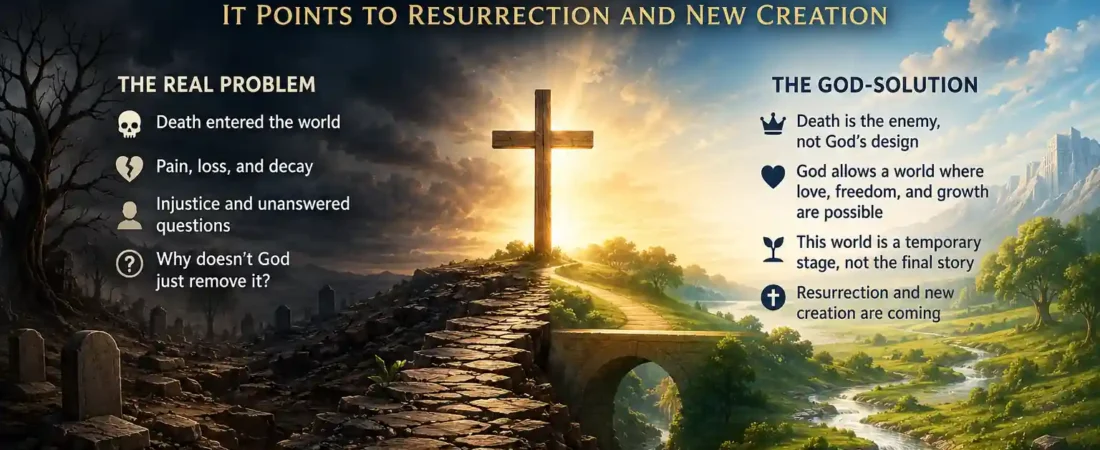
The Problem of Removing Death: Why a Deathless Version of This World Is Not as Simple as It Sounds
Christianity calls death an enemy. But removing death from this biological world would require much more than deleting funerals.
2-Minute Gist
Death exists in our universe because God is neither stupid nor cruel. The universe would have to be fundamentally different for death not to be a priority.
The question of why a loving, all-powerful, and all-knowing God would include death in the universe is much easier to answer than the question of how a universe exists in which death is absent but where the parallel universe (Heaven) is somehow better without it.
That said, Christians should not romanticize death. Scripture calls death “the last enemy,” and the Christian hope is resurrection and new creation — not pretending death is inherently good.[1]
When people ask why God did not simply make a world without death, the question is more complicated than it first sounds.
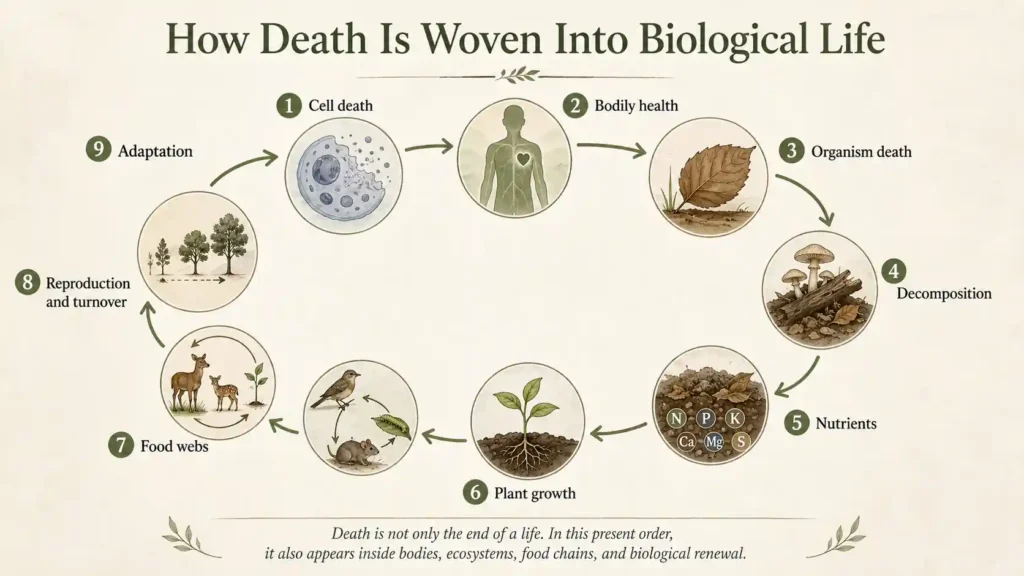
Death is not only the final moment at a funeral. Life as we know it is deeply structured around death. Cells die so bodies can develop, heal, and remove dangerous cells.[2][3] Dead organisms decompose so nutrients return to the soil.[5] Food chains, ecosystems, reproduction, population turnover, adaptation, and evolutionary history all depend on mortality.[7][8][10] Even human civilization developed under conditions of danger, scarcity, disease, labor, and death.[9]
There is another uncomfortable point: in a fallen world, death can also function as a boundary. It can end unbearable suffering for some, and it can limit the earthly career of tyrants, abusers, torturers, and murderers. A world where death is removed but evil remains would not automatically be heaven. Imagine immortal Hitlers, immortal slave masters, immortal traffickers, immortal torturers, and victims with no earthly exit.
So a deathless version of this world is not merely this universe with funerals removed.
If death were eliminated while bodies, reproduction, finite land, finite food, finite water, ecology, disease, evil, coercive power, and resource limits remained the same, flourishing would not automatically follow. The world would face cascading biological, ecological, moral, and social problems.[7][13] To remove death and still have flourishing would require a radically different kind of creation.
This article is not saying death is good. It is not saying grief is irrational. It is not saying cancer, slavery, murder, plague, torture, or the death of a child is emotionally or morally easy. It is making a narrower point: removing death from this kind of biological and fallen world is not a simple edit.
Christian hope is not this world with death deleted. It is resurrection, judgment, healing, and new creation.[14]

Source note: This article uses brief numbered citations so the main text stays readable. Full source notes, access details, and citation-honesty explanations are included near the bottom.
Christians should not romanticize death
Christianity does not teach that death is simply good.
That needs to be said first.
Paul calls death “the last enemy” in 1 Corinthians 15:26. Revelation 21:4 looks toward the day when death, mourning, crying, and pain are no more. Jesus Himself wept at the tomb of Lazarus, even though He knew He was about to raise him.[1]
Christian hope is not emotional numbness. It is resurrection.
So this article is not trying to explain away grief. It is not saying death is beautiful in itself. It is not saying people should look at tragedy and say, “Well, at least ecology works.”
That would be cruel.
The question here is narrower:
If God simply removed death from this present biological world while leaving everything else mostly the same, would that automatically create a better world?
The answer is not obvious.
Christianity can affirm two truths at once:
Biologically, death is woven into this present creation.
Theologically, death is still an enemy Christ defeats.
Those truths are not contradictions. They are different levels of analysis.
What exactly would “no death” mean?
When someone says, “Why didn’t God just make a world without death?” the question sounds simple.
But what kind of death are we removing?
Do we mean:
- No human death?
- No animal death?
- No plant death?
- No cell death?
- No microbial death?
- No predation?
- No decomposition?
- No extinction?
- No aging?
- No decay at all?
Each answer creates different problems.
If only human death is removed, death remains embedded in the rest of creation.
If animal death is removed but plant death remains, then death still exists.
If plant death is removed too, eating becomes hard to imagine, because embodied creatures in this world are sustained by other living things.
If cell death is removed, bodies stop working normally.[2][3]
If all death, decay, and biological breakdown are removed, then we are no longer talking about this world with one unpleasant feature deleted. We are talking about a radically different kind of creation.
That matters because “a world without death” can sound like a small moral improvement. Depending on what is meant, it may require the redesign of bodies, food, reproduction, ecosystems, disease, aging, digestion, immunity, and perhaps the basic physical conditions of life.
Death is not only what happens at funerals; cell death helps bodies live
One of the most overlooked facts is that death does not only happen to whole organisms.
Death happens inside living bodies all the time.
Your body is made of cells. Those cells grow, divide, repair, age, get replaced, and sometimes need to be removed. Some cells are useful for a time and then need to disappear. Some become damaged. Some become infected. Some begin behaving abnormally.
One of the body’s protective systems is controlled cell death. When a cell is no longer needed, badly damaged, infected, or dangerous, the body can trigger processes that remove it. Modern biology describes cell death as essential for organismal development and adult tissue balance.[2]
This matters especially when thinking about cancer.
Cancer is not usually a foreign invader from outside the body. It often begins when some of the body’s own cells stop obeying the normal limits that keep cell growth under control. The National Cancer Institute describes cancer as diseases in which abnormal cells divide without control and can invade nearby tissues.[4] Healthy cells are supposed to divide when appropriate, stop when appropriate, repair damage when possible, and die when they become too damaged or dangerous. Cancer cells, in simplified terms, are cells that escape some of those controls. They keep surviving, keep dividing, and may invade or damage surrounding tissues.[3][4]
So a body where damaged or abnormal cells never die would not be a healthier body. It may become a body where dangerous cells accumulate.
This is one reason the “just remove death” objection becomes complicated. If death is removed too absolutely, we are not merely removing funerals. We may also be threatening embryonic development, wound repair, immune function, tissue balance, infection control, and cancer prevention.[2][3]
So the question becomes:
Can God remove death and still preserve embodied flourishing?
Christians can say yes, ultimately, because God can create resurrection life and new creation. But that is not the same as saying God could simply remove death from this present biological system while leaving everything else unchanged.
A deathless body would not merely be a current human body that never has a funeral. It would have to be a different kind of body.
Ecosystems depend on death, decomposition, and renewal
Death is also woven into ecosystems.
When plants and animals die, decomposers and soil organisms break down dead organic matter and return nutrients to biological circulation. The University of Illinois Soil Quality project describes decomposition as central to nutrient cycling because it releases carbon and nutrients from complex living material, making them available to plants and other organisms.[5] Decay is not merely waste. In this present ecosystem, it is part of renewal.
A forest without death is not simply a happier forest. It is a forest where nutrient cycling, soil renewal, population balance, food webs, and biological space would all have to be redesigned.
Death is connected to:
- soil fertility
- nutrient cycling
- food webs
- population turnover
- ecological balance
- new growth
- adaptation across generations
If death is removed, something else has to replace all of those functions.
That does not make death emotionally easy. It does mean death is not an isolated defect that can be removed without consequence.
Synthetic Materials That Take a Long Time to Decompose are Problematic on Waste
One of the problems especially of the past century is the volume of synthetic materials that have been created (i.e. plastic) that don’t “die” very easily. They take an incredibly long time to decompose. That has created a waste problem the likes of which the world has never known. The land and the waters in some places are heavily polluted and filled with various kinds of waste. It’s negatively impacted various kinds of life, in part because of how long it takes to decompose.
Because they take so long to die, they can exist in microscopic form and permeate many waters all over the world. Typical synthetic plastic solves a short term solution, but creates a major long term problem. Man’s attempt at “conquering death” in one sense has caused a lot of problems that were not known at all when plastics were initially invented. It’s a great example of how man’s attempt to bypass God’s natural design can sometimes backfire in ways that weren’t initially imagined even if it adds a degree of short term convenience.
I personally still use plastics at times, but prefer dishes, utensils, & otherwise without plastic, especially in cases where food or drink is heated in such a way that microplastics would be added. The old Testament has a codified road map of avoiding sickness and disease that was very beneficial in its time. While Christians are no longer bound to observe the Old Testament law, that doesn’t mean that the high prioritization of health is no longer a priority to God.
1 Corinthians 6:19-20 “Do you not know that your body is a temple of the Holy Spirit who is in you, whom you have received from God? You are not your own; you were bought at a price. Therefore glorify God with your body.”
Also, study of health goes along with the Tanach/Old Testament values of gaining wisdom (i.e. in matters like microplastics) & is an example of how study outside the Bible based on new findings is so important to gain holistic wisdom.
As Proverbs 4:7 states, “The beginning of wisdom is this: Get wisdom. Though it cost all you have, get understanding.”
What does embodied life eat in a deathless world?
In this world, living things are sustained by other living things. Even a vegetarian diet involves the destruction or death of plant tissue, seeds, cells, and microbial life. Soil fertility depends partly on decomposed organic matter.[5][6] Food chains depend on life being transformed into life.
If animal death alone were removed, the world would already have to change dramatically.
If plant death were removed too, the change would be far greater.
If cell death and microbial death were also removed, then ordinary digestion, immunity, decomposition, and agriculture would have to be redesigned.[2][3][5]
So the problem is not only predators eating prey. It is deeper than that.
Embodied biological life as we know it is dependent. Creatures receive life from outside themselves. They are not self-sustaining spirits floating above the world.
This is why Christian hope should not be imagined as the same food chain with death magically deleted. It is a transformed creation.
Overpopulation is not a cheap objection; it is a real design problem
If creatures reproduce but do not die, population pressure becomes a serious design problem very quickly. In ecology, populations do not grow without limit forever; food, competition, disease, and other resource constraints eventually limit growth around an environment’s carrying capacity.[7] This does not mean death is good. It means that reproduction plus finite resources plus no death creates cascading pressures that cannot be solved by merely deleting funerals.
A world with reproduction but no death would face pressure on land, food, water, shelter, sanitation, energy, ecosystems, disease control, social order, habitat space, agriculture, and waste systems.
Modern people sometimes imagine a deathless world as though it would be our present world, only happier. But if death disappeared while reproduction continued, population pressure would become enormous.
Someone might respond, “People could use technology to solve that.” But this assumes modern technology would already exist. Much of human civilization and technology developed in response to embodied vulnerability and need: agriculture supported denser settlements and the growth of towns and cities; sanitation systems developed in response to disease and urban mortality; and energy systems have shaped civilization from foraging societies to the fossil-fuel era.[9]
A deathless pre-technological world could not simply borrow solutions produced through a long mortal history.
In other words:
A deathless ancient world could not easily solve deathless-world problems with technologies produced through a mortal world.
That does not prove God could not create a deathless world. It shows that He would have to create a very different world.
“Couldn’t God just make Earth bigger?”
A larger Earth might sound like a shortcut: if overpopulation is the problem, just make more room.
But a much larger rocky Earth would not be merely a bigger map. Planetary size, mass, radius, gravity, atmosphere, geology, climate, and habitability are connected. NASA/JPL’s planetary data illustrate the basic point that surface gravity is calculated from mass and radius.[15]
More space might slow a population-pressure problem, but if reproduction is unbounded and death is removed, it does not solve the problem. It pushes the redesign deeper.
So the larger-Earth objection actually reinforces the main point:
A deathless version of this world requires not a minor adjustment, but cascading redesign.
Genesis requires careful interpretation before science even enters the discussion
Before we discuss evolution, death, and creation, one clarification matters.
Neither this author nor Saint Augustine, writing in The Literal Meaning of Genesis around AD 415, limits faithful interpretation of Genesis 1–3 to the idea that the early chapters must be read as simple, strictly literal history in every modern sense.[16]
Augustine cared deeply about the literal meaning of Genesis. But even he recognized that Genesis raises difficult interpretive questions and that Christians should not pretend every detail is obvious.
That point matters before we even discuss modern science.
Some internal tensions already arise when Genesis 1–3 is forced into the flattest possible reading. Genesis 1 and Genesis 2 do not present creation in exactly the same literary shape. Genesis speaks of “days” before the creation of the sun and moon. Adam and Eve’s “eyes” are said to be opened after sin, even though the story already portrays them seeing before that moment.
These details do not make Genesis false.
They do show that the text is more sophisticated than simplistic literalism allows.
So when this article discusses evolution, death, and creation, it is not doing so because Scripture must be bent to fit modern science. It is making a more basic point: Christians have long recognized that Genesis requires careful interpretation.
The question is not whether we take Genesis seriously.
The question is whether we take it seriously enough to read it according to its actual literary and theological character.
Evolution, intelligence, and the role of death
With that clarification in mind, evolution as we know it depends heavily on death.
Natural selection involves differential survival or reproduction over time. UC Berkeley’s Understanding Evolution defines natural selection in terms of differential survival or reproduction among genotypes, requiring variation, heredity, differential reproduction, and time.[8]
Without death, extinction, reproductive limits, and generational turnover, evolution as we know it would be radically altered.
This matters because complex life, sentience, and intelligence did not simply appear in a static world. They emerged through a long biological history of adaptation, vulnerability, cooperation, competition, predation, and death.
This is one reason evolutionary theodicy exists. Christopher Southgate’s work is especially important here. Robert John Russell summarizes Southgate’s proposal as a “compound only-way evolutionary theodicy,” engaging the relationship between evolutionary biology, thermodynamics, suffering, death, horrendous evil in nature, and eschatological hope.[10] Southgate’s own book presents pain, suffering, and extinction as intrinsic to the evolutionary process and asks how a world that is “very good” can also be “groaning in travail.”[11]
But this point must be handled with moral caution.
The argument is not that earlier creatures were disposable raw material for later creatures. God’s care for creation cannot be reduced to human benefit.
So the careful point is this:
If one removes death from the evolutionary process, one is not merely removing a painful side effect. One is removing one of the central mechanisms by which life as we know it developed.
That does not make death good in the final Christian sense. It means death is structurally entangled with this present biological order.
And that brings us back to the article’s larger point: a world without death is not merely this world with one painful feature removed. If death is removed from biology, ecology, reproduction, evolution, and moral history all at once, we are no longer talking about a small adjustment. We are talking about a radically different kind of creation.
Natural challenge matters, but it should not all come from evil people
Challenges help give life meaning.
Courage requires danger. Endurance requires difficulty. Compassion often awakens in response to suffering. Patience requires delay. Forgiveness requires wrong. Sacrifice requires cost. Discipline requires resistance.[12]
This is part of what philosophers and theologians often call soul-making: a world with real difficulty can be an arena where mature character forms.[12]
But there is a serious problem if all meaningful challenge comes only from human evil.
If the only source of challenge were murderers, abusers, tyrants, torturers, liars, and betrayers, then evil people would become too central to the formation of virtue. That would make moral evil feel almost necessary to human growth.
Natural limitation provides another kind of arena.
Sickness, weakness, aging, weather, difficult labor, hunger, risk, physical limits, and the need to care for vulnerable bodies can create occasions for courage, compassion, responsibility, dependence, discipline, and love without requiring a villain in every case.
This does not make natural suffering easy. It does not explain every disease. It does not mean God delights in pain. But it does show why a world with natural difficulty may be morally different from a world where all serious difficulty is caused by human cruelty.
Natural challenge prevents moral evil from becoming the only school of character.
In a fallen world, death can be a boundary
This is uncomfortable, but it matters.
Christianity calls death an enemy. But in a fallen world, death can also function as a boundary.
It can end unbearable suffering for some. Someone trapped in torture, slavery, starvation, terminal disease, or relentless bodily agony may experience death as release — not because death is good, but because the suffering is so terrible.
Death can also limit the earthly career of evil people.
Imagine an immortal Hitler. Or an immortal Stalin, Mao, Pol Pot, slave trader, cartel lord, serial killer, torturer, trafficker, or abusive tyrant. If death were removed while moral evil remained, the result would not automatically be a better world. It could become a world where the worst people have unlimited time to consolidate power, refine cruelty, and keep victims trapped.
This does not make death morally beautiful. It means that, in a world where evil exists, mortality can restrain evil’s duration.
That point matters. A world without death but with sin, oppression, disease, trauma, and coercive power intact would not be paradise. It could be a nightmare of endless captivity.
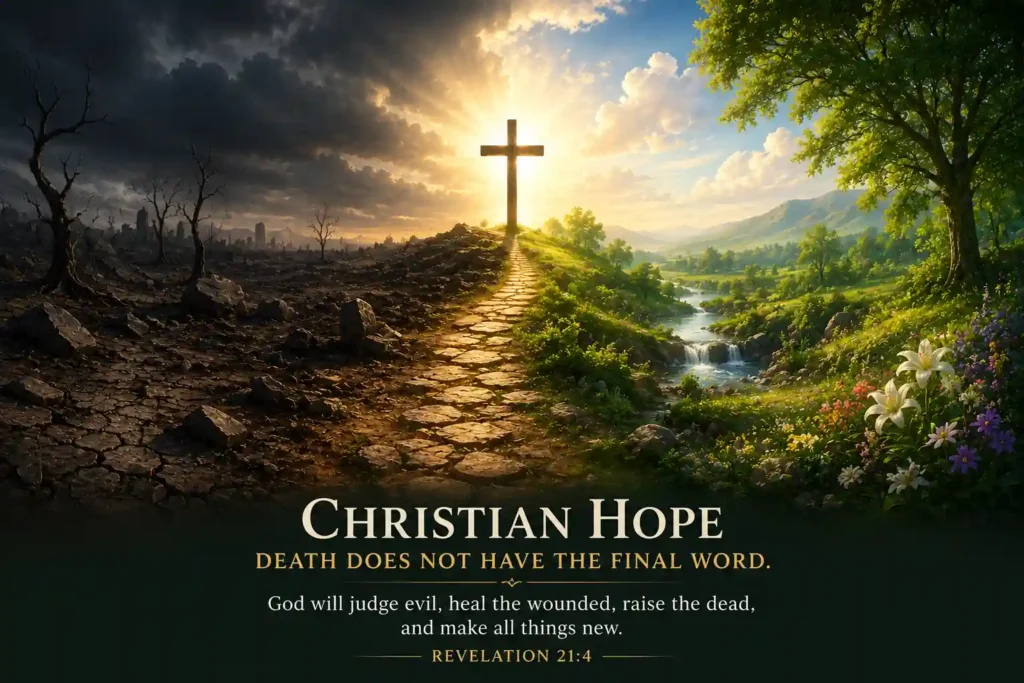
The Christian hope is not merely that no one dies. It is that God judges evil, heals the wounded, raises the dead, and makes all things new.[14]
This point must be handled with pastoral care. It should never be used to encourage self-destruction or to treat vulnerable lives as disposable. The claim is not that suffering people should die. The claim is that in a fallen world, death sometimes ends suffering that should never have existed in the first place.
Stable natural laws matter
Embodied life requires stable natural laws.
If fire cooks, it can also burn. If water nourishes, it can also drown. If gravity lets us walk, build, and live on a planet, it can also injure us when we fall. If bodies are biological, they can be wounded. If cells divide, some cells can divide wrongly. If ecosystems are real, they can be disrupted.
A world where every dangerous consequence is constantly suspended would not be this world. It would be a miracle-machine, not a stable natural order.
Natural-law theodicy argues that stable laws of nature provide a great good: a stable environment needed for rational choices, even though those laws also allow natural disasters and other harms.[13]
That matters because stable natural laws make planning, science, responsibility, moral action, agriculture, engineering, medicine, and ordinary life possible.
Christianity has room for miracles. But a world made entirely of constant exceptions would not be the same kind of world.
But does this make God dependent on death?
No.
This article is not arguing that God needs death in an ultimate sense. God is not dependent on death. God is life.
The argument is narrower:
Given this kind of biological, ecological, moral, reproductive, finite world, removing death is not a simple improvement.
God could create a radically different world. Christian hope says He will bring resurrection and new creation.[14] But that future hope should not make us careless in how we imagine this present creation.
A deathless world is possible for God.
But a deathless version of this exact biological and moral order is not easy to imagine coherently.
So the article’s claim is not:
Death is good.
The claim is:
Death is structurally woven into this present order, and removing it would require a radically different order.
That distinction matters.
The Christian answer is not ecology alone; it is resurrection
If this article ended with ecology, it would be incomplete.
Christianity does not finally answer death by saying, “Well, ecosystems need it.”
Christianity answers death with the cross and resurrection of Jesus Christ.[14]
Jesus did not explain death from a safe distance. He entered a world of betrayal, injustice, violence, grief, and mortality. He suffered death. Then He rose.
That matters because Christianity is not merely a philosophical defense of the world as it is. It is also a proclamation that the world as it is will not remain forever.
Death is woven into this creation, but death does not get the final word.
The St Andrews Encyclopaedia of Theology notes that resurrection theology involves questions about whether resurrection restores original perfection or brings about a new creation that exceeds the first, and whether death is a natural good or a consequence of sin.[14] That is exactly why this article should not end with ecology. Christianity’s hope is not merely biological continuation. It is transformed life in God’s renewed creation.
So we should say all three truths clearly:
Death is biologically entangled with life as we know it.
Death is morally entangled with a fallen world where evil needs boundaries.
Death is theologically an enemy Christ defeats.
The final Christian hope is not merely this universe with funerals removed. It is a world made new.
What this argument should not be used for
This argument should not be used at a funeral.
It should not be used beside a hospital bed.
It should not be used to silence grief.
It should not be used to tell a grieving parent, widow, child, or friend that death is fine because ecosystems need turnover.
That would be morally foolish.
There is a time to analyze the structure of creation, and there is a time to weep.
Jesus Himself wept at the tomb of Lazarus, even though He knew He was about to raise him.[1] That should discipline Christian speech. If Jesus did not treat grief as irrational, neither should we.
This article is for philosophical and theological reflection. It is not a pastoral script for raw grief.
The Christian response to death includes thinking, but it also includes lament, presence, compassion, prayer, and hope.
Conclusion — Not merely this universe with funerals removed
A world without death sounds simple until we ask what death is doing in this world.
Death is involved in cell biology, bodily development, immune defense, cancer prevention, decomposition, nutrient cycling, ecosystems, food, reproduction, population turnover, evolution, civilization, technology, and the formation of human responsibility under real limits.[2][3][5][7][8][9][10][13]
In a fallen world, death can also function as a boundary: ending some unbearable suffering and limiting the earthly reach of evil people.
This does not make death good in the final Christian sense.
It does mean that removing death from this kind of world is not like removing one ugly stain from an otherwise unchanged painting. It would require a radically different painting.
The Christian hope is not that God will merely erase funerals while leaving the rest of the present order untouched. The Christian hope is resurrection and new creation — not the denial of death’s horror, but its defeat.[14]
Death is an enemy.
But it is an enemy so deeply woven into this present biological and moral order that its final removal requires not a small adjustment, but the renewal of all things.
Full Sources, Notes, & Deeper Study
The main article uses brief numbered citations so the reading experience stays clean. This section gives the fuller source trail: Scripture references, academic sources, public-facing sources, access notes, and explanation of how each source is being used.
Not every source makes the article’s full argument directly. Some sources support individual claims; the larger argument is Adam/YGod synthesis.
[1] Death as enemy; Jesus and grief
Sources:
1 Corinthians 15:26; Revelation 21:4; John 11:35–44.
Related passages:
Isaiah 25:8; Romans 8:18–25; 2 Timothy 1:10; Hebrews 2:14–15.
Used for:
These passages support the article’s opening guardrail: Christianity does not romanticize death. Death is called “the last enemy.” Revelation looks forward to a world where death, mourning, crying, and pain are no more. Jesus grieves at the tomb of Lazarus, even though He knows resurrection is coming.
Source note:
This source group keeps the article from becoming emotionally careless. The argument is not that death is good, beautiful, or trivial. Christianity’s final posture toward death is resurrection hope, not sentimental acceptance.
[2] Cell death and organismal development/homeostasis
Source:
“A Guide to Cell Death Pathways,” Nature Reviews Molecular Cell Biology 24 (2023): 671–690.
https://www.nature.com/articles/s41580-023-00689-6
Used for:
Supports the claim that cell death is essential to organismal development and adult tissue balance/homeostasis.
Source note:
This source does not make a theological argument. It supports the biological premise that “removing death” becomes complicated if death is considered at the cellular level, not only at the funeral level.
[3] Regulated cell death, infection, inflammation, and tumorigenesis
Source:
Ein Lee, Chang-Hyun Song, Sung-Jin Bae, Ki-Tae Ha, and Rajendra Karki, “Regulated Cell Death Pathways and Their Roles in Homeostasis, Infection, Inflammation, and Tumorigenesis,” Experimental & Molecular Medicine 55 (2023): 1632–1643.
https://www.nature.com/articles/s12276-023-01069-y
Used for:
Supports the role of regulated cell death in homeostasis, infection response, inflammation, damaged-cell removal, and cancer-related processes.
Source note:
This source strengthens the sections on cell death, immune function, and the danger of imagining a body where damaged or abnormal cells simply never die.
[4] Cancer explanation
Sources:
National Cancer Institute, “What Is Cancer?”
https://www.cancer.gov/about-cancer/understanding/what-is-cancer
National Cancer Institute, “Cancer — Definition.”
https://www.cancer.gov/publications/dictionaries/cancer-terms/def/cancer
Used for:
Supports the plain-language explanation that cancer involves abnormal cells dividing without control and sometimes invading nearby tissues.
Source note:
This source is used for accessible wording. The article’s point is not that all cancer is simply “failed cell death.” Cancer is biologically complex. The narrower point is that normal bodily health depends on cells being regulated, repaired, stopped, or removed when necessary.
[5] Decomposition and nutrient cycling
Primary source:
University of Illinois, Soil Quality for Environmental Health, “Nutrient Cycling.”
https://soilquality.nres.illinois.edu/nutrient-cycling/
Accessible supplemental source:
National Geographic Society, “Decomposers.”
https://education.nationalgeographic.org/resource/decomposers/
Used for:
Supports the claim that decomposition returns nutrients to biological circulation and makes them available to plants and other organisms.
Source note:
This source supports the ecosystem section. The article is not claiming that decomposition makes death emotionally good. It is claiming that decay plays a real function in the present ecological order.
[6] Food webs / decomposition background
Supplemental source:
Arizona State University, “Decomposition.”
https://eoss.asu.edu/sites/g/files/litvpz141/files/Decomposition.pdf
Used for:
Supports the explanation that decomposition breaks organic material into smaller molecules that primary producers can use again.
Source note:
This source is supplemental. It helps explain the connection between dead organic material, nutrients, producers, and food webs.
[7] Population growth and carrying capacity
Sources:
Encyclopaedia Britannica, “Population Ecology — Logistic Population Growth.”
https://www.britannica.com/science/population-ecology/Logistic-population-growth
Encyclopaedia Britannica, “Carrying Capacity.”
https://www.britannica.com/science/carrying-capacity
Used for:
Supports the general ecological point that population growth is constrained by food, competition, disease, and other environmental/resource limits.
Source note:
This source does not argue that death is good or that God uses death merely as population control. It supports the narrower ecological premise that finite environments impose limits on population growth. The deathless-world application is Adam/YGod synthesis.
[8] Natural selection and differential reproductive success
Sources:
UC Berkeley Understanding Evolution, “Natural Selection.”
https://evolution.berkeley.edu/glossary/natural-selection/
UC Berkeley Understanding Evolution, “Differential Reproductive Success.”
https://evolution.berkeley.edu/glossary/differential-reproductive-success/
Used for:
Supports the basic evolutionary claims about differential survival/reproduction, adaptation, and population change over time.
Source note:
This citation supports the scientific background, not the theological interpretation. The theological interpretation is handled through evolutionary-theodicy sources below.
[9] Technology-history and civilization development
Agriculture source:
Johns Hopkins Center for a Livable Future, Food System Primer, “History of Agriculture.”
https://foodsystemprimer.org/production/history-of-agriculture
Public health source:
Theodore H. Tulchinsky and Elena A. Varavikova, “A History of Public Health,” The New Public Health, via PubMed Central.
https://pmc.ncbi.nlm.nih.gov/articles/PMC7170188/
Sanitation source:
Werner Troesken, “Urbanization, Sanitation, and Mortality in the Progressive Era, 1899–1929.”
https://link.springer.com/chapter/10.1007/978-3-031-06477-7_1
Energy/civilization source:
Vaclav Smil, Energy and Civilization: A History. MIT Press.
https://direct.mit.edu/books/book/3576/Energy-and-CivilizationA-History
Used for:
Supports the narrower claim that much of human civilization developed through agriculture, sanitation, energy use, and responses to embodied vulnerability and need.
Source note:
This is one of the article’s more synthetic points. The sources support major historical connections between vulnerability, agriculture, disease, sanitation, energy, and civilization. They do not directly prove every counterfactual claim about what would happen in a deathless world. The article’s application to a deathless pre-technological world is Adam/YGod synthesis.
[10] Southgate / Russell: compound evolutionary theodicy
Source:
Robert John Russell, “Southgate’s Compound Only-Way Evolutionary Theodicy: Deep Appreciation and Further Directions,” Zygon 53, no. 3 (2018).
https://www.zygonjournal.org/article/id/14502/
Used for:
Supports the discussion of Christopher Southgate’s compound evolutionary theodicy and the relationship between evolutionary biology, suffering, death, struggle, extinction, and eschatological hope.
Source note:
This is a key bridge source. It helps connect biological death and suffering to existing Christian theological discussion rather than making the article sound as if it invented the whole evolutionary-theodicy conversation.
[11] Southgate primary source
Source:
Christopher Southgate, The Groaning of Creation: God, Evolution, and the Problem of Evil. Louisville: Westminster John Knox Press, 2008.
Author/book page:
https://christophersouthgate.org.uk/the-groaning-of-creation-god-evolution-and-the-problem-of-evil-paperback/
Used for:
Primary source for evolutionary theodicy, creaturely suffering, death, extinction, and eschatological hope.
Source note:
Use this source carefully. This article is not claiming Southgate would endorse every conclusion here. Southgate is being used as an important example of Christian theological reflection on evolution, suffering, death, and creation’s groaning.
[12] Soul-making theodicy
Source:
John Hick, Evil and the God of Love. 2nd ed. New York: Harper & Row, 1978.
Accessible overview:
The Gospel Coalition, “The Problem of Evil.”
https://www.thegospelcoalition.org/essay/the-problem-of-evil/
Used for:
Supports the broad soul-making idea that a world with real difficulty can be an arena for mature character.
Source note:
The specific claim that “natural challenge prevents moral evil from becoming the only school of character” is Adam/YGod synthesis. Hick supports the broader soul-making category, not necessarily that exact formulation.
[13] Natural-law / stable-order theodicy
Accessible overview:
The Gospel Coalition, “The Problem of Evil.”
https://www.thegospelcoalition.org/essay/the-problem-of-evil/
Academic source:
Richard Swinburne, “Natural Evil,” American Philosophical Quarterly 15, no. 4 (1978): 295–301.
https://www.jstor.org/stable/20009727
Related book source:
Richard Swinburne, Providence and the Problem of Evil. Oxford: Oxford University Press, 1998.
Used for:
Supports the stable natural-law / ordered-world framework: natural processes make meaningful embodied life possible while also permitting harm.
Source note:
The article’s examples — fire cooking and burning, water nourishing and drowning, gravity enabling movement and causing injury — are explanatory illustrations. The broader category is natural-law or ordered-world theodicy.
[14] Resurrection and new creation
Scripture sources:
Isaiah 25:8; Romans 8:18–25; 1 Corinthians 15; Revelation 20–21.
Academic overview:
St Andrews Encyclopaedia of Theology, “Resurrection of the Dead.”
https://www.saet.ac.uk/Christianity/ResurrectionoftheDead
Accessible book source:
N. T. Wright, Surprised by Hope: Rethinking Heaven, the Resurrection, and the Mission of the Church. New York: HarperOne, 2008.
Used for:
Supports the claim that Christian hope is resurrection and new creation, not mere disembodied escape or this biological order with death simply deleted.
Source note:
This source group is especially important for the conclusion. The article should not end with “death has ecological functions.” It should end with the Christian claim that God will defeat death through resurrection and new creation.
[15] Planetary physical parameters / surface gravity
Source:
NASA/JPL Solar System Dynamics, “Planetary Physical Parameters.”
https://ssd.jpl.nasa.gov/planets/phys_par.html
Used for:
Supports the narrow point that surface gravity is related to mass and radius.
Source note:
This source does not prove that a larger Earth could not sustain life. It only supports the more modest claim that planetary redesign involves physical tradeoffs. This citation is used only because the article briefly addresses the “Couldn’t God just make Earth bigger?” objection.
[16] Augustine and careful interpretation of Genesis
Source:
Saint Augustine, De Genesi ad litteram / The Literal Meaning of Genesis, completed around AD 415.
Reference page:
Library of Congress, De Genesi ad litteram.
https://www.loc.gov/item/2021668097/
Used for:
Supports the point that serious Christian interpretation of Genesis has long involved careful literary and theological judgment, and that Augustine’s concern for the “literal” meaning of Genesis should not be equated with simplistic modern flat literalism.
Citation honesty:
This article is not claiming Augustine held modern evolutionary views. He did not. The point is narrower: long before modern origins science, major Christian thinkers already recognized that Genesis required careful interpretation and should not be handled with careless overconfidence.
Recommended deeper study
For readers who want to go deeper, start with these:
-
1 Corinthians 15 — death as enemy and resurrection as Christian hope.
-
Romans 8:18–25 — creation groaning and awaiting redemption.
-
Christopher Southgate, The Groaning of Creation — evolutionary suffering and Christian theodicy.
-
Richard Swinburne, “Natural Evil” — stable natural processes and natural evil.
-
N. T. Wright, Surprised by Hope — resurrection and new creation.
-
Augustine, The Literal Meaning of Genesis — early Christian wrestling with Genesis interpretation.
Original Synthesis and Citation Honesty
This article’s central argument is an original synthesis. It is not claiming that any one source makes the entire argument exactly this way.
The sources support the components:
- Scripture supports the claim that death is an enemy and that Christian hope is resurrection and new creation.
- Cell biology supports the claim that regulated cell death is essential to development, homeostasis, immune response, and cancer-related processes.
- Ecology supports the claim that decomposition and nutrient cycling are part of present ecosystems.
- Population ecology supports the claim that finite environments have carrying capacities and resource limits.
- Evolutionary biology supports the claim that natural selection involves differential survival/reproduction, variation, heredity, and time.
- Evolutionary theodicy supports the claim that death, suffering, struggle, extinction, and creaturely development are deeply entangled in Christian reflection on the evolutionary emergence of complex life.
- Soul-making theodicy supports the broad claim that real difficulty can form courage, endurance, compassion, patience, sacrifice, and responsibility.
- Natural-law theodicy supports the claim that stable natural processes are necessary for meaningful embodied life, even though those processes permit harm.
- Resurrection theology supports the claim that Christian hope is not merely deathless biological continuation, but transformed life in God’s renewed creation.
- Augustine’s Genesis work supports the narrower claim that careful Christian interpretation of Genesis has long been more serious than simplistic flat literalism.
The article’s larger claim is this:
Removing death from this present biological, ecological, moral, and finite order is not a simple edit. It would require a radically different kind of creation.
That larger conclusion is Adam/YGod synthesis.
It is built by combining Scripture, biology, ecology, population reasoning, evolutionary theodicy, natural-law theodicy, Genesis interpretation, and moral reflection.
Readers should not assume every cited source endorses every part of Adam/YGod’s final argument. Some sources support individual building blocks. The article brings those building blocks together.
Several claims especially require careful wording:
Technology-history claim:
The article does not claim to prove that technology could never develop in any deathless world. The narrower point is that much of actual human civilization and technology developed in response to embodied vulnerability, scarcity, disease, mortality, and need.
Larger-Earth claim:
The article does not claim that a larger Earth is impossible. The narrower point is that changing planetary scale is not just “adding more room.” Mass, radius, gravity, atmosphere, geology, climate, and habitability are connected.
Death-as-boundary claim:
The article’s claim that death can function as a boundary in a fallen world is moral reasoning, not a command, policy proposal, or pastoral script. It should never be used to encourage self-harm, euthanasia, neglect, or the devaluing of vulnerable lives. The point is that in a world where evil and extreme suffering exist, mortality can limit the duration of suffering and the earthly reach of evil.
Overpopulation claim:
The article is not making a political population-control argument. The point is that reproduction plus finite resources plus no death creates design pressures that cannot be solved by simply deleting death.
Evolutionary-theodicy claim:
The article does not imply that creaturely suffering is casually justified because it led to humans. God’s care for creation cannot be reduced to human benefit. The point is that death and biological development are deeply entangled in this present evolutionary order.
Genesis claim:
The article does not claim Augustine believed in modern evolution. He did not. The point is that serious Christians have long recognized that Genesis requires careful interpretation, and that simplistic confidence about every detail of Genesis 1–3 is not the only historically serious Christian option.
In short, this article is not saying:
Death is good.
It is saying:
Death is an enemy so deeply woven into this present biological and fallen order that removing it would require not a small adjustment, but the renewal of all things.
AI-Assistance Disclosure
Dropdown 18 — AI-Assistance Disclosure
This article was developed through an iterative collaboration between Adam Garrett and OpenAI’s GPT model.
Adam supplied the core argument, theological framing, conceptual direction, examples, editorial judgment, and final responsibility for the article. AI assistance was used to help organize the article, test objections, identify supporting categories and sources, draft and refine language, and distinguish directly sourced claims from Adam/YGod synthesis.
AI did not replace Scripture, prayer, theological judgment, source review, or Adam’s responsibility for what is published.
Final responsibility for the article’s claims, tone, citations, theological framing, and publication belongs to Adam Garrett.
For more, see: How YGod Uses AI.