Exploring faith, reason, and what shapes our understanding of existence.
Why God? Questions That Matter
This Site is Under Construction
Exploring if belief in God stands as a rational explanation through philosophy, science, history, religious texts (i.e. the Bible), & quantitative data.
Exploring Bias:
Engaging some topics commonly discussed & bringing up some others that are far more important than people realize due to the subconscious bias they have for or against God as well as the religion, philosophy, or de facto secular gods that people find themselves worshiping in practice even if not in name (i.e., sex, drugs, money, power, etc.).
God is Not Just an Intellectual Question:
The question of God isn’t merely intellectual; it’s a question of the heart & of purpose in life. It’s a question where the answer can bring more than peace – shalom, even in tumultuous circumstances. That shalom isn’t merely an ephemeral anaestetizing experience, but rooted deeply in truth. It’s also a question with major cost involved in light of the impact on purpose & direction in life.
One of the top theologians of all time was a man who lived in North Africa who we know as Saint Augustine. He had been a Manichean before converting to Christianity. Manicheans were a group that believed that the Bible had been corrupted over time. In Saint Augustine’s Confessions (written around 400 AD), he wrote about how he needed to not just lean toward Christianity being true intellectually, but be thoroughly convinced in light of the heavy cost on his life the implications of that conscious assent would have. Many aren’t able to recognize as clearly (especially where they actually make it publicly known later) the conscious vs subconscious influences involved in the question of God like that.
Compare Religions:
Explore some principles true of God from multiple views (i.e. Christianity & other religions like Judaism) & some exclusive to Christianity or focused on the Old Testament that Judaism & Christianity share (with the Protestant Old Testament & the Jewish Bible aligning most closely among major Christian groups including Roman Catholics & the Orthodox Churches).
Go Deeper:
We acknowledge that religion without relationship and without a positive change of the heart is severely lacking, no matter its outward appearance or the rigor of its adherence to certain codes of conduct. We challenge those who believe in God to go deeper in the fullness of who He is & what He has for those He loves.
Many Aren’t Aware How Data Backed the Bible is on Morality:
One of the top reasons why people reject various versions of God is that they don’t believe or don’t want to believe certain variants of morality, and believe that religious treatment of those views is unjust. What if many popular assumptions of the data on certain subjects, i.e., abstaining from sex before marriage and abstaining from cohabitation before marriage, have a lot more objective data-backed reasoning than people think?
Following the Bible is for the Benefit of Man:
The words of the Bible are provided for the benefit of man and for the flourishing of humanity. People doing good don’t provide any tangible benefit to God that He couldn’t provide via alternative non-human means. Obeying the Bible is beneficial primarily to the person obeying, to humanity, & to the world. It’s not merely abstaining from evil; it’s in part the promotion of good, even if it’s costly in certain terms. God is omniscient, so His revelation on cost benefit analysis will often not make sense, but in history, & especially in the past century, more and more findings have revealed just how much what God says is good is good if one looks carefully at the data, even if that data isn’t commonly known or focused on even in many religious circles.
See the Data:
One of the top goals of this site is to show the data so that you can both see how the data lines up with the moral precepts of God (specifically those laid out in the Bible, but with many parallel religious moral beliefs lining up at times) & see how the data backed nature of abiding by those precepts provides a net positive to the individuals who adhere to them and to the world, which provides one of the indicators of divine inspiration of the Hebrew & Christian Bibles.
Hypocrisy:
Adherents of faith often don’t do what their religious text says, so another significant goal of this site is to distinguish between what those who call themselves Christians or those of other faiths do or have done historically (i.e. the 4th crusade) and practice vs what their religious text teaches.
Challenging Some Popular Theology:
We challenge religious views at times when those views pose a social threat to humanity, whether in the past or in the present (i.e., climate change denial, wife beating, terrorism, etc.). We also challenge views that pose more indirect threats, i.e., the primary call of man from God, which varies substantially by religion, but which is to love God & to love people.
Case Example on Theological Challenge: We explore various avenues of psychology, such as the impact of herd bias on US evangelicals to differ from global evangelicals on issues like climate change, cultivating moral apathy in creation care despite the importance of creation care as a major responsibility inherent in the first role of man given in the first few pages of the Bible in Genesis 1:26 (translated as rule, dominion, authority, etc. over animals & all the earth) & Genesis 2:15: “The LORD God took the man and put him in the garden of Eden to work it and keep it.” The role in creation care is reflected in various other passages, including directly (i.e., John 6:12 on not wasting food & Proverbs 12:10 on avoiding animal cruelty) & indirectly in passages on stewardship.
Why God?
God is Reasonable
Is belief in God rational? Oxford mathematician John Lennox argues above that faith in God is not a retreat from reason but a conclusion consistent with science, philosophy, and human experience.
A little video like that is insufficient to turn one’s life around. A deep dive into this issue is critical if one wants to follow the rabbit hole wherever it leads to find the truth. No matter what faith one grows up in or what faith one finds oneself today, it’s critical to pursue the truth wherever it leads, and to not allow a minimalist approach and subconscious pulls that one might not even realize are the true drivers rule one’s life theologically and in terms of one’s purpose. A fulfilling life of lasting positive consequence resulting in true joy is available if one seeks the Way, the Truth, & the Life.
Christianity Rests on Objective Truth
The call to “blind faith” is the call to be blind as a bat, to seek wisdom & reason even for those matters which aren’t obvious, rather than giving in to various forms of bias such as confirmation bias, anchoring bias, self-serving bias, herd bias, etc. Much emphasis is placed on bias of those who are religious; too seldom are the bias that impact those who depart from faith explored.
In his classic work, “Confessions”, Augustine of Hippo was honest about how the evidence had to become overwhelmingly clear for him to convert to Christianity due to self-serving bias & other forms of bias. Few are as self-aware, and even less are willing to admit it.
Importance of Wisdom (Proverbs)
Whether you have faith or not, wisdom is a highly valuable tool for those who have it. With wisdom, many aspects of life can be much better than those without it & with those who don’t pursue it, whether finances, family, significance, peace, or joy.
Proverbs 4:7-9
The beginning of wisdom is this: Get wisdom. Though it cost all you have, get understanding. Cherish her, and she will exalt you; embrace her, and she will honor you. She will give you a garland to grace your head and present you with a glorious crown.
Proverbs 3:13-18
13 Blessed are those who find wisdom, those who gain understanding, 14 for she is more profitable than silver and yields better returns than gold. 15 She is more precious than rubies; nothing you desire can compare with her. 16 Long life is in her right hand; in her left hand are riches and honor. 17 Her ways are pleasant ways, and all her paths are peace. 18 She is a tree of life to those who take hold of her; those who hold her fast will be blessed.
See also: Reason
Key Old Testament Text on Importance of Objective Truth in the Bible & Jesus
Deuteronomy 4
32 “Indeed, ask now concerning the former days which were before you, since the day that God created man on the earth, and inquire from one end of the heavens to the other. Has anything been done like this great thing, or has anything been heard like it? 33 Did any people ever hear the voice of God speaking out of the midst of the fire, as you have heard, and live? 34 Or has any god ever attempted to go and take a nation for himself from the midst of another nation, by trials, by signs, by wonders, and by war, by a mighty hand and an outstretched arm, and by great deeds of terror, all of which the Lord your God did for you in Egypt before your eyes? 35 To you it was shown, that you might know that the Lord is God; there is no other besides him.”
Key New Testament Text on Importance of Objective Truth in the Bible & Jesus
1 corinthians 15: 1 Now I would remind you, brothers, of the gospel I preached to you, which you received, in which you stand, 2 and by which you are being saved, if you hold fast to the word I preached to you—unless you believed in vain.
3 For I delivered to you as of first importance what I also received: that Christ died for our sins in accordance with the Scriptures, 4 that he was buried, that he was raised on the third day in accordance with the Scriptures, 5 and that he appeared to Cephas, then to the twelve. 6 Then he appeared to more than five hundred brothers at one time, most of whom are still alive, though some have fallen asleep. 7 Then he appeared to James, then to all the apostles. 8 Last of all, as to one untimely born, he appeared also to me. 9 For I am the least of the apostles, unworthy to be called an apostle, because I persecuted the church of God. 10 But by the grace of God I am what I am, and his grace toward me was not in vain. On the contrary, I worked harder than any of them, though it was not I, but the grace of God that is with me. 11 Whether then it was I or they, so we preach and so you believed.
12 Now if Christ is proclaimed as raised from the dead, how can some of you say that there is no resurrection of the dead? 13 But if there is no resurrection of the dead, then not even Christ has been raised. 14 And if Christ has not been raised, then our preaching is in vain and your faith is in vain. 15We are even found to be misrepresenting God, because we testified about God that he raised Christ, whom he did not raise if it is true that the dead are not raised. 16For if the dead are not raised, not even Christ has been raised. 17And if Christ has not been raised, your faith is futile and you are still in your sins. 18Then those also who have fallen asleep in Christ have perished. 19If in Christ we have hopeb in this life only, we are of all people most to be pitied.
For more on the historical Jesus, see Ygod’s page on the subject.
See also Ygod’s page on Biblical reliability
Danger of Delusion When Objective Truth Isn’t Present in Religion
All religious paths don’t lead to the same place, and the purpose of them is not the same. This site will be cataloguing some of the similarities and differences of religions over time across the world. The volume of truth vs falsehood varies considerably by the text:
- Some religious texts are intentionally vague on history, with little that can be done to disprove it because of it.
- Other religious texts are intentionally explicit, but have many obvious flaws because of it that are hard to explain away.
- In rare cases, i.e. the Tanakh/Old Testament as well as (to a lesser degree) the New Testament, there is both a high volume of history that is corroborated by archaeology as well as laws (in the case of the Old Testament/Hebrew Bible) and morality that are more and more being proven as the ideal, as data backing it becomes available, even if that data isn’t popularly known all the time.
Richard Dawkins is the author of The God Delusion, the most popular atheist book in modern times, which defends atheism. If he read the Bible before authoring it, he may have noticed that the Bible itself & notable authors of the faith & other people of faith after it, like Saint Augustine in “City of God” claimed in book 5 that Astrology itself is a delusion.” He claimed that many other views of gods were the result of delusion, affirming that in the absence of objective truth, the notion of god or other mystical views can very easily be a result of delusion.
Isaiah 41:27-29 27 ESV I was the first to say to Zion, “Behold, here they are!” and I give to Jerusalem a herald of good news. 28 But when I look, there is no one; among these there is no counselor who, when I ask, gives an answer. 29 Behold, they are all a delusion; their works are nothing; their metal images are empty wind.
Jeremiah 10:14-15 ESV (repeated in Jeremiah 51:17-18)
[14] Every man is stupid and without knowledge; every goldsmith is put to shame by his idols, for his images are false, and there is no breath in them.
[15] They are worthless, a work of delusion; at the time of their punishment they shall perish.
Danger of Delusion by Resolute Rejection of Evidence Even if It Points to an Uncomfortable Truth
One kind of delusion is belief in a false god or gods when the evidence doesn’t support that, whether one props up “gods” subconsciously (i.e. sexual “freedom”, money, power, etc.), or whether one consciously & outwardly worships that which one consciously claims to be a god or gods. Another kind of delusion is rejection of God even when one sees that the evidence leans toward it being reality, even though there may be elements that are difficult to grasp or accept (i.e. the trinity).
In Stave One of the fictional “A Christmas Carol”, published in 1843 by Charles Dickens, there’s a curious interaction between Scrooge & Jacob Marley’s ghost, the first ghost he sees:
“You don’t believe in me,” observed the Ghost.
“I don’t,” said Scrooge.
“What evidence would you have of my reality beyond that of your senses?”
“I don’t know,” said Scrooge.
“Why do you doubt your senses?”
“Because,” said Scrooge, “a little thing affects them. A slight disorder of the stomach makes them cheats. You may be an undigested bit of beef, a blot of mustard, a crumb of cheese, a fragment of an underdone potato. There’s more of gravy than of grave about you, whatever you are!”
Lee Strobel in the documentary film (not the re-enactment version) The Case for Christ said, “”I’d really encourage you if you’ve never done it to investigate the evidence for yourself but make three resolutions up front: #1 make it a front burner issue in your life #2 resolved to have an open mind- to go wherever the evidence takes you, even if it takes you to the very uncomfortable conclusion that Jesus is who he claimed to be, and then finally resolve that once the evidence is in you will reach a verdict in the case for Christ.”
The Cost of Discipleship & Why the Cost is Part of the Intellectual Rejection
Acceptance of Christianity is sometimes pitched as “free”, but while God is not receiving anything He doesn’t already have in the exchange or could replace, in many ways, it’s very costly.
Jesus said that one must be willing to give up everything one holds dear to follow Him. If following Him means giving up your very family, which is the case of some faiths where following Jesus may lead to your family not being willing to speak to you again, is it worth it to you? Also, for some faiths, and in some contexts, faith in Jesus could mean that you are killed. Is He worth it? Is truth worth it? Is following in the way of Life for your future generations worth it?
Jesus said in Luke 14 (in some regards literally, and in some regards, i.e. the first verse, figurately/comparatively but not literally), “26 “If anyone comes to me and does not hate father and mother, wife and children, brothers and sisters—yes, even their own life—such a person cannot be my disciple. 27 And whoever does not carry their cross and follow me cannot be my disciple.
28 “Suppose one of you wants to build a tower. Won’t you first sit down and estimate the cost to see if you have enough money to complete it? 29 For if you lay the foundation and are not able to finish it, everyone who sees it will ridicule you, 30 saying, ‘This person began to build and wasn’t able to finish.’
31 “Or suppose a king is about to go to war against another king. Won’t he first sit down and consider whether he is able with ten thousand men to oppose the one coming against him with twenty thousand? 32 If he is not able, he will send a delegation while the other is still a long way off and will ask for terms of peace. 33 In the same way, those of you who do not give up everything you have cannot be my disciples.”
There’s a lot of focus by atheists and agnostics on the bias of those who are religious, especially in terms of their origins. Insufficient attempts are made to point out the bias toward objective truth in the form of religion if that truth is too costly in certain regards. To give up atheism or agnosticism & to accept any religion that has established objective truth principles on morality, one must give up moral self-determinism. One must give up certain activities or goals that in some cases are defining aspects of people’s focus of existence. One must acknowledge that one is wrong, and that one needs to grow to be a better person, often in many regards. One must acknowledge in many cases that the purpose of life is not what one has been chasing after. Acknowledging that and living in light of that reality is costly.
In the face of a high cost to acceptance of a religion when the evidence is high toward the truth of that religion (i.e. Judaism or Christianity), intellectual rejection on other various grounds is often a cover for why one won’t accept it. That can even include lies consciously to oneself about the reasoning for the rejection, while the subconscious reasoning (the cost) is repressed. One can think a bit about the conscious reasons, ask a pastor who is unwilling to thoughtfully engage over time or who isn’t the best person to ask due to intellectual disparity between the person asking and the person answering, and then give up, without much more digging than that. One can say, “I tried.” Why work hard to find the truth when the truth is seemingly so costly if it really is true?
Dietrich Bonhoeffer in Nazi Germany wrote, “The Cost of Discipleship.” It was published in German in 1937. Faith cost him his life. He even said in it, “When Christ calls a man, he bids him come and die.” Intellectual assent is insufficient. As Bonhoeffer wrote, “Only he who believes is obedient, and only he who is obedient believes.”
Likewise, James 2 (vs 14-26) states that “faith without works is dead.” It’s not real. If I believe that my glass of water is good to drink. If I don’t, I won’t drink it. If I drink the wrong cup, which may be poisoned, I could die.
In John 12:24, Jesus says, “Very truly I tell you, unless a kernel of wheat falls to the ground and dies, it remains only a single seed. But if it dies, it produces many seeds.” Jesus was willing to die so that we could be free. It was worth it.
In Galatians 2:20, Paul says, “I have been crucified with Christ and I no longer live, but Christ lives in me. The life I now live in the body, I live by faith in the Son of God, who loved me and gave himself for me.” In 2 Corinthians 11:23-29, Paul, who formerly rejected Jesus and pursued the imprisonment of killing of Christians, goes over a wide variety of major hardships he faced, i.e. torture and attempts on his life. He ultimately paid for his faith in Jesus with his life. However, Paul also said during his life, in Philippians 4:12-13, “I know what it is to be in need, and I know what it is to have plenty. I have learned the secret of being content in any and every situation, whether well fed or hungry, whether living in plenty or in want. I can do all this through him who gives me strength.”
People Tend to Overestimate Their Wisdom
People greatly overestimate their wisdom, even those who should know better through a high level of study. The Greek philosopher Socrates is attributed to have said, “True knowledge exists in knowing that you know nothing.” Hundreds of years before Socrates was alive, Proverbs 26:12 stated, “Do you see a man wise in his own eyes? There is more hope for a fool than for him.”
The Importance of Understanding Psychology & Bias
One of the most important ways to identify our lack of wisdom and lack of reliance on pure intelligence is to understand how significantly psychology & bias impact us. For those who seek to arrive at truth, it’s foolish to neglect the study of psychology & bias & assume that intellectual or life-orienting questions like matters of faith can be arrived at through reason alone. Ignoring psychology and bias is intellectually neglectful in the 21st century. Even those who have never studied it in college or university can begin studying it for free online.
Atheists and agnostics tend to emphasize bias far more than adherents of faith, but bias and psychology play a massive role in people departing the faith as well. Typically, people consciously uphold their faith (including faith in atheism) with an intellectual backbone, while subconsciously, without many of them even realizing it, other factors are often the driving force.
For an example of a strong psychological pull against most faiths, see the next section.
Sex & Porn: Examples of Pyschological Draws Away from Faith with Traditional Views on Sex
An example of a strong psychological pull against faith when faith discourages sexual deviation is “sexual freedom”. Especially if one doesn’t have the objective data about why engaging in “sexual freedom” outside of marriage even if physically “protected” to a limited degree by contraception is an ultimately self-harming (& harming of consenting partners, future children, & society) idea, and one actively engages in pornography or pre-marital sex, there will be a degree of emotional turmoil that pulls one away from their faith (if that faith discourages such practices) subconsciously, and that keeps one away from faith if they depart.
It’s important to be aware of, for instance, the impact of oxytocin (produced by sex, porn, masturbation, etc.) & other hormones/neurotransmitters on judgment. The ultimate impact of oxytocin is positive within the context of marriage, keeping it together, while negative outside of marriage if it involves sex even though it feels great. Interestingly, the street drug ecstasy (methylenedioxymethamphetamine) also increases oxytocin substantially. There’s even a non-religious website that’s been developed to fight porn called “Fight the New Drug.” It has an article on “How Porn Can Affect the Brain Like a Drug.” Sex often has higher amounts of many of the same hormones involved with porn.
A study published in 2021 on “The Relationship Between Sexual Compulsivity, Emotional and Spiritual Distress of Religious and Non-religious Internet Pornography Users” found that “Emotional distress and spiritual distress were found to be significantly higher for SCs (sexually compulsive) than the NCs (non-sexually compulsive) regardless of religiosity.” Interestingly, “The non-religious were significantly more anxious and stressed than the religious.”
The Importance of Studying Logic
For anyone seeking wisdom, it’s logical to study logic. Logical fallacies are much easier to avoid if we are aware of them. Likewise, we’ll be able to spot them in others if we know about them rather than be persuaded by them, whether or not the person using them that we hear from or are reading is aware of them.
I recall an occasion at a city hall of a city of over 100k people where the literal majority of arguments made by the city council regarding a topic was based in logical fallacies. That’s how pervasive they can be even by those who are elected based in part on their supposed wisdom.
While Christian apologist William Lane Craig with Reasonable Faith uses these, in many cases, those in opposition to faith are more likely to be familiar with them, and if defenders of faith fail to be knowledgeable about them, it’s more likely that arguments will be called out by those in opposition as being logically fallacious.
What Does the Bible Really Say?
An essential element of this site is correcting improper understandings of objective truth & of the Bible.
Case Example 1A: Love in the Bible is Essential
One common misunderstanding about the Bible by both those who identify as Christians & those who reject Christianity is about love. The biblical emphasis of charitable (agape) love is essential.
See biblical text examples demonstrating that below starting with the Old Testament/Hebrew Bible & then with the New Testament as well as Ygod’s page on Agape love
Hebrew Bible/Old Testament of Christians:
Many view the God of the Old Testament as harsh and cruel, not the loving God of the New Testament. That’s far from the truth with a number of articles I plan to use to demonstrate that covering topics like slavery, war, sacrifice, & more. The God of the Hebrew Bible/Old Testament is the same God as in the New Testament.
Psalm 102:25-27 says, “In the beginning You laid the foundations of the earth, and the heavens are the work of Your hands. / They will perish, but You remain; they will all wear out like a garment. Like clothing You will change them, and they will be passed on. / But You remain the same, and Your years will never end.”
Passages that point to the emphasis of love in the Old Testament:
- Leviticus 19:18 You shall not take vengeance or bear a grudge against the sons of your own people, but you shall love your neighbor as yourself: I am the LORD.
- Joshua 5:13-14 – where it’s clear that following the Lord, not being born in Abraham’s bloodline, matters more to God, while not looking down on the privilege of that blood line that such a low % of the population have the gift of.
- Ruth from the book of Ruth (A Moabite – not a Jewish person) being in the blood line of David
- The Babylonian exile of the Jewish people for being unfaithful; God was unwilling to continue protecting them while they were practicing evil.
- The way that the restrictions and admonitions in the Old Testament are structured for the benefit of man.
- The Abrahamic blessing that “and in your offspring shall all the nations of the earth be blessed, because you have obeyed my voice (Genesis 22:18).”
- The many times that the prophets highlighted how justice, mercy, and faithfulness were even more important than following the sacrificial system & feasts (i.e., Isaiah 1, 58, Micah 6:6-8, Zechariah 7, Hosea 6:6, etc.)
1 John 4:20 Whoever claims to love God yet hates a brother or sister is a liar. For whoever does not love their brother and sister, whom they have seen, cannot love God, whom they have not seen.
Matthew 22: 36“Teacher, which is the great commandment in the Law?” 37And He said to him, “ ‘YOU SHALL LOVE THE LORD YOUR GOD WITH ALL YOUR HEART, AND WITH ALL YOUR SOUL, AND WITH ALL YOUR MIND.’ 38“This is the great and foremost commandment. 39“The second is like it, ‘YOU SHALL LOVE YOUR NEIGHBOR AS YOURSELF.’ 40“On these two commandments depend the whole Law and the Prophets.”
Keep in mind that “The Law & the Prophets” was all of the Hebrew Scripture (that we have in the Old Testament) at the time Jesus said it. However, some today have discarded objective truth under misguided notions of love. If we do not find objective truth, our ability to truly help others, to connect to the source of Love, & to help ourselves will always be lacking. The Kingdom of Heaven comes to earth when we live in harmony with God, & in doing so, live in harmony with ourselves, other people, & with nature.
- Galatians 5:14 For the entire law is fulfilled in keeping this one command: “Love your neighbor as yourself.
- 1 Corinthians 13
1B. Love with God & Objective Truth Yield Joy
John 15:1-17 & 1 John 4:7-21 are key here, especially John 15:1-17.
In John 15:1-17, we see that as we commune with God, dive deep into His Word, put His Word into our hearts, and walk according to His Word, especially in our actions that demonstrate our love for others, the end result is a life that is fruitful, and we experience true joy.
In 1 John 4:7-21, we see that God is love, and that as we commune with God, His love gets poured out in and through us to a world in need, and fear in our hearts is eliminated, driven out by the overwhelming power of His love.
1C. The Problem of Bad Theology on Love
Bad theology on love can go in opposite directions.
- On the one hand, love at the expense of faith can discard many of the methods of loving well in truth and the source of Love.
- On the other hand, the absence of the importance of love as a prominent theological element has had terrible consequences in Christian history, with the conquistadores’ (i.e. Christopher Columbus) pursuit of “Gold, God, & glory” while raping, pillaging, and plundering being a prime example. Another example is the 4th crusade, where Christians sacked Christian cities (including more raping, pillaging, and plundering) to come up with the money to eventually retake Jerusalem (without ever setting foot within 1000 miles of Jerusalem when it was all said and done), and in doing so, by sacking Constantinople, paved the way for Muslim armies to take it in the future.
1D. Is the Site Host a Love Pro? No
I affirm that it would be to my own benefit to be a “pro” in loving God and others, a result of a life lived in communion with God (that I have tasted but that I do not encounter daily), where joy unspeakable can flow even in the hardest of days. That said, I lack the wisdom & moral fortitude to walk in that, while pointing to it and seeking it daily, despite many failures in that search.
I do not claim to be righteous, but I am thankful that God has helped me to persevere in seeking the way of life.
Paul said in 1 Corinthians 11:1, “Be imitators of me, as I am of Christ.” I go wayward too frequently on a daily basis for me to commend anyone to do that for me. Even with my son, a toddler, there are actions that I engage in where I tell my toddler not to be like me where I point to the harm caused of doing so.
Case Example 2A Christian Discipleship is Intrinsically God’s Grace on Us; If the Concept of Heaven Didn’t Exist in the Bible or in Reality, the Christian Life Would Still be Worth it
One of the purposes of this site is to eventually catalogue a high volume of examples of biblical commands that are demonstrated to be beneficial to humanity, even if people don’t recognize them as such due to the bias of popular secular psychology, using objective data to do so. Some of these are even denied as inherently good in part due to anti-Christian bias. The concept of premarital sex & the related subject of premarital cohabitation are 2 such well-studied subjects with clear objective results in line with the Bible that the general population, as well as Christians, are seldom aware of.
Hebrew Bible/Old Testament of Christians:
Deuteronomy 10:12-14 states, “And now, Israel, what does the Lord your God require of you, but to fear the Lord your God, to walk in all his ways, to love him, to serve the Lord your God with all your heart and with all your soul, and to keep the commandments and statutes of the Lord, which I am commanding you today for your good? Behold, to the Lord your God belong heaven and the heaven of heavens, the earth with all that is in it.
Psalm 1: “Blessed is the man
who walks not in the counsel of the wicked,
nor stands in the way of sinners,
nor sits in the seat of scoffers;
2 but his delight is in the law of the Lord,
and on his law he meditates day and night.
3 He is like a tree
planted by streams of water
that yields its fruit in its season,
and its leaf does not wither.
In all that he does, he prospers.
4 The wicked are not so,
but are like chaff that the wind drives away.
5 Therefore the wicked will not stand in the judgment,
nor sinners in the congregation of the righteous;
6 for the Lord knows the way of the righteous,
but the way of the wicked will perish.”
Psalm 119:32 says (WEB), “I run in the path of your commandments, for you have set my heart free.”
New Testament of Christianity:
Jesus said in Mark 2:27 ““The Sabbath was made for man, not man for the Sabbath.” Mathew Henry’s Commentary on Mark 2, vs 27 states, “What a good Master we serve, all whose institutions are for our own benefit, and if we be so wise as to observe them, we are wise for ourselves; it is not he, but we, that are gainers by our service.”
A Metaphor from a Movie:Following God is certainly costly, but it’s worth it. It can be compared to a speech in the film “Braveheart” by William Wallace, played by Mel Gibson, with the video below including some additional context:
“I am William Wallace. And I see a whole army of my countrymen, here in defiance of tyranny! You have come to fight as free men. And free man you are! What will you do without freedom… Fight and you may die. Run and you will live, at least a while. And dying in your beds many years from now, would you be willing to trade all the days from this day to that for one chance, just one chance, to come back here and tell our enemies that they may take our lives but they will never take our freedom!”
2B Biblical Discipleship is Not Us Doing God a Favor
Job 35:7 “If you are righteous, what do you give Him, or what does He receive from your hand?”
Hebrew Bible/Old Testament of Christians:
Psalm 50:10-12 (in the context of the sacrificial system of the Old Testament)
“for every beast of the forest is Mine—the cattle on a thousand hills. / I know every bird in the mountains, and the creatures of the field are Mine. / If I were hungry, I would not tell you, for the world is Mine, and the fullness thereof.”
Job 41:11 “Who has given to Me that I should repay him? Everything under heaven is Mine.”
New Testament of Christianity:
Romans 11:35-36 ““Who has ever given to God, that God should repay them? For from him and through him and for him are all things. To him be the glory forever! Amen.”
1 Corinthians 4:7 “For who makes you so superior? What do you have that you did not receive? And if you did receive it, why do you boast as though you did not?”
1 Corinthians 15:10 “But by the grace of God I am what I am, and his grace to me was not without effect. No, I worked harder than all of them—yet not I, but the grace of God that was with me.”
See also: God Doesn’t Need Us; We Need Him
Case Example 3A: Creation Care for the Environment
If you ask many US evangelicals (especially among those who don’t go to parks, go hunting, nor fishing – the author does all 3, especially parks), many are relatively apathetic about care for the environment. One who has never read the Bible might think that it’s simply not important to God, but that’s far from the truth.
The difference in historically black Christians vs white evangelicals here is stark, with historically black Chiristians tending to be significantly more environmentally conscious (double the percentage in the chart below believing that global climate change is an extremely/very serious problem and less than 1/4 the percentage believing that it is “not/not too” serious of a problem), pointing to the political herd bias that drives US white evangelical (a camp which I fall in) environmental apathy. Republicans don’t tend to be promoters of environmentalism, while Democrats do tend to do that, and most black protestants are Democrats, while most Evangelicals are Republicans.
As I go over at length in my guide on Weather & Environmental Conditions That Affect Homeownership in Virginia, the environment and climate change have a high personal impact on the lives of many in the US, more than many realize.
Why Climate Change Matters: A Christian Case for Taking it Seriously
Here is some of what the Bible says on creation care:
Hebrew Bible/Old Testament:
- The first purposes mentioned in the Bible of man is one of caring for the earth. Genesis 1:26 states of man, Then God said, “Let us make man in our image, after our likeness. And let them have dominion over the fish of the sea and over the birds of the heavens and over the livestock and over all the earth and over every creeping thing that creeps on the earth.” Genesis 2:15 states, “The Lord God took the man and put him in the garden of Eden to work it and keep it.”
- One environmental case of stewardship is found in Deuteronomy 20:19 (AMP) ““When you besiege a city for a long time, making war against it in order to capture it, you shall not destroy its [fruit-bearing] trees by swinging an axe against them; for you may eat from them, and you shall not cut them down. For is the tree of the field a man, that it should be besieged (destroyed) by you?”
- The Old Testament/Tanach also prohibits cruelty to animals. Proverbs 12:10 states, “A righteous man has kind regard for the life of his animal, But even the compassion of the wicked is cruel.” Specific laws were in place for that protection, i.e., prohibiting cooking “a young goat in its mother’s milk” in Exodus 23:19, prohibiting muzzling an ox while it reads out the grain in Deuteronomy 25:4, requiring helping a donkey stumbling under a load even if it belongs to your enemy in Exodus 23:5, prohibiting taking a wild mother bird who has eggs (while allowing the taking of eggs) in Deuteronomy 22:6-7, & stating that the weekly day off (sabbath rest) for animals was similar to that of people in Exodus 20:10, where they could do no work.
- The Old Testament/Tanach also includes food laws that appear to be geared toward keeping a clean & productive environment, prohibitions against eating shellfish & fish without scales.
- The principle of stewardship is a major overarching theme of the Bible mentioned in numerous passages. Matthew 25:14-30 is a prime example, where, rather than increasing the money given to them, they dug it away and hid it, and were rebuked for it, while those who increased what they were given were praised for it.
- One environmentally conscious example is John 6:12. In that case, after God has miraculously multiplied bread and fish that were given, Jesus commands that none of the leftovers be wasted. “And when they had eaten their fill, he told his disciples, “Gather up the leftover fragments, that nothing may be lost.”
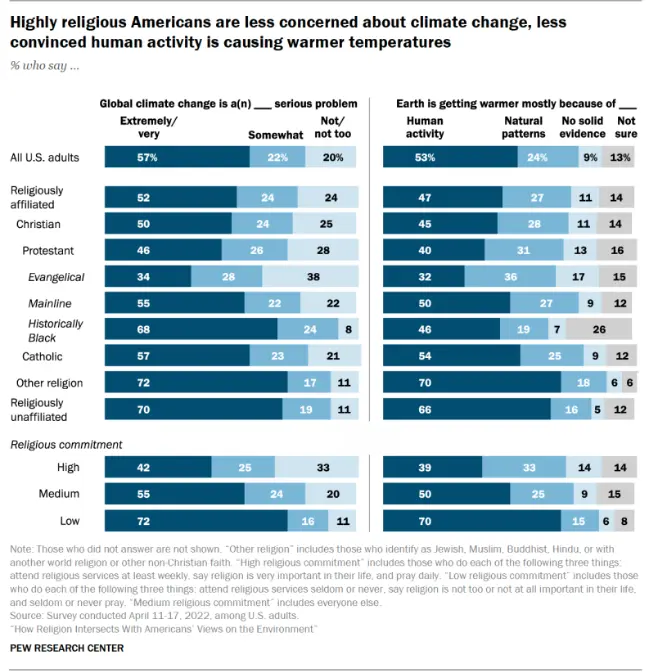
3B The Cape Town Commitment in 2010, Endorsed by the World Evangelical Alliance, the Largest Umbrella Group for Global Evangelicals, Spoke Directly About Fighting Climate Change
Evangelicals globally don’t have the degree of herd bias regarding environmental apathy as those evangelicals in the US who are influenced by Republican leanings toward that apathy. Because of that, there is a disparity between global evangelicals on the environment vs white evangelicals in the US.
The Cape Town Commitment, endorsed by many, including the top umbrella group of evangelicals in the world (the World Evangelical Alliance, who helped draft it), representing over 400 million of them (“128 national evangelical alliances located in 7 regions and 104
associate member organizations”) at the time, stated:
- Humans were causing a significant amount of climate change,
- The negative impact on people of climate change
- The need to change the world to be a better place.
Latest Insights