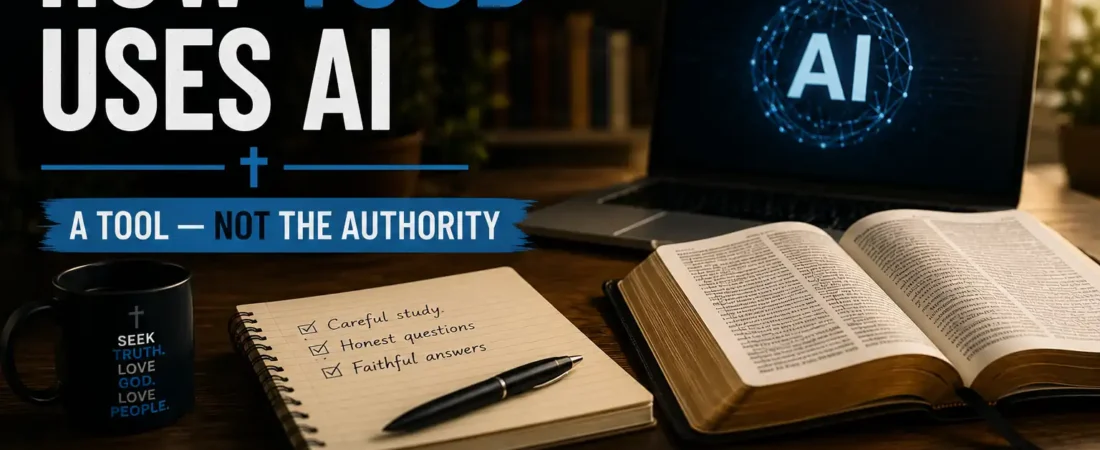
How YGod Uses AI
Some YGod articles and pages are developed with AI assistance as part of the writing, research, editing, organization, and review process. Other content may be written or developed without AI assistance. Because this site deals with God, Jesus, Scripture, theology, doubt, ethics, evidence, morality, and spiritual life, I believe substantial AI use should be disclosed clearly.
When AI is used, it does not replace my responsibility for what appears on YGod. I remain responsible for the final claims, wording, arguments, citations, theological judgments, source choices, and publication decisions.
The short version
YGod uses AI because careful, well-sourced, publishable work takes far more time than I currently have without assistance. AI helps reduce bottlenecks in research, organization, drafting, revision, critique, and clarity.
But AI is not the authority. God is not replaced by technology. Scripture, not AI, is the uniquely authoritative written witness by which Christian teaching must be tested. AI may assist the process, but it must never become the source of spiritual authority or moral truth.
YGod is not meant to be “AI theology.” It is a Christian resource that may use AI tools under human responsibility and, ultimately, accountability before God.
More detail on what this means
AI may help me brainstorm article ideas, organize complex topics, compare viewpoints, identify possible objections, support research workflows, draft sections, revise wording, check tone, and improve clarity.
But AI does not replace God, Scripture, prayer, conscience, the Holy Spirit, careful study, Christian community, scholarship, pastoral wisdom, or human accountability before God and readers.
For questions of faith, morality, discipleship, and spiritual life, God is the authority, and Scripture is the uniquely authoritative written witness by which Christian teaching must be tested. AI can be a useful tool, but it is not spiritually authoritative.
Why I use AI
The primary reason I use AI is time. Even as I write this article with assistance from AI, it’s taking time away from my wife & toddler after 8 PM at night.
To research, organize, write, revise, source, critique, and polish the kinds of resources I want YGod to provide would take far more time than I currently have without AI assistance. I am not using AI because I have no thoughts, no convictions, no writing experience, or no theological background. I use it because careful, publishable work takes an enormous amount of time, and YGod is being built within real limits of family, work, ministry, energy, and finances.
For years, I wanted to do much of what YGod is now beginning to do: help people honestly explore God, Jesus, Christianity, the Bible, doubt, hard questions, and spiritual life. But time constraints were and remain a severe limiting factor.
More about the time and resource limits behind YGod
Before using AI in this kind of workflow, I often had nearly as many unfinished drafts as published articles on my business website because getting ideas from rough draft to publishable form took more time than I had available. In fact, I still have far more research/unfinished work as I do published work.
Those limits were not theoretical. After more than four years serving in youth and children’s ministry, I eventually needed to step back because my business career required more time and focus. I wanted to provide better for my family, have more time for my wife, be in a better position to have children, and not raise kids while constantly worrying about money. My final assignment in that ministry role was helping find my replacement.
That experience shapes how I think about YGod. I do not have unlimited time. I need more time for my family, more time in Scripture, more time in prayer, and a more self-sustaining income from my business work if I am going to serve effectively through YGod over the long run.
I also do not currently have the funds to hire the level of writing, editing, research, design, strategy, and administrative help that a project like YGod could easily require. AI does not replace the wisdom, accountability, discernment, scholarship, pastoral care, or lived experience of real people. But it does help me move forward responsibly in a season where the alternative is often not “hire a full team,” but “leave important work unfinished.”
If you believe in YGod’s mission, donations and volunteer help are appreciated. Financial support, research help, editing help, design help, technical help, prayer, source recommendations, and thoughtful feedback can all help make the project stronger.
My background before using AI
AI did not create my interest in theology, apologetics, Scripture, ministry, or hard questions.
I have a master’s degree in Practical Theology from Regent University in Virginia Beach and a bachelor’s degree in Christian Education with a minor in Bible from Wheaton College. More about my professional background is available on my LinkedIn profile. Before using AI in this kind of writing workflow, I had already written hundreds of articles without AI assistance, especially through my business writing.
I also read or listen through the entire Bible at least once every year, along with devotional study and deeper study when working through specific biblical, theological, historical, ethical, or apologetic questions.
Example of no-AI writing
One example of my writing before using AI in this kind of workflow is:
Why Does God Forbid Premarital Sex & Cohabitation?
https://ygod.net/why-does-god-forbid-premarital-sex-cohabitation/
That article is an example of the kind of moral, theological, biblical, and practical reasoning I was already trying to do before AI became part of my writing workflow. I do not point to it because I think it is perfect. I point to it because it helps show that YGod did not begin with detached prompts to software. It grows out of long-standing interests, education, ministry experience, Scripture engagement, and prior writing work.
Other pre-AI examples may also be added over time, especially from older business writing and any faith-related writing that helps readers understand my background.
How AI helps the process
AI helps reduce some of the bottlenecks that previously kept important work stuck in draft form. It can function somewhat like a research assistant, debate partner, editor, organizer, and clarity-checker.
Used responsibly, AI can help me make better use of limited time and limited resources without pretending that speed, polish, or productivity are the same thing as wisdom.
Examples of how AI may assist
AI may help with:
- brainstorming article ideas
- outlining complex topics
- comparing different viewpoints
- identifying possible objections
- testing whether wording is clear
- improving organization
- summarizing source material for further review
- suggesting sources to investigate
- drafting possible sections
- revising awkward wording
- checking whether a claim sounds overstated
- making an article more understandable for skeptics, seekers, doubting Christians, wounded-by-religion readers, and Christians seeking deeper understanding
Those uses can be helpful, but they do not make AI authoritative. AI can assist with the process; it cannot replace truth, wisdom, Scripture, prayer, or accountability.
My use of AI is always iterative
My use of AI is never a one-prompt process where I ask a machine to write an article and then publish the result.
Much of the work is highly iterative. Articles and pages may be shaped through repeated rounds of correction, refinement, theological clarification, source checking, audience analysis, structural revision, and critique. Even after publication, I may go back and add content with or without AI.
Over time, these conversations have also included substantial context about my theological education, ministry goals, writing standards, ethical concerns, continuationist convictions, concern for objective truth, desire for careful sourcing, and commitment to distinguishing core Christian doctrine from disputed matters where faithful Christians may disagree.
Why the iterative process matters
The more directed and iterative the process is, the less it resembles “push a button and publish whatever AI says.”
I often ask AI to challenge weak arguments, identify overstatements, compare alternative framings, suggest clearer organization, and help make material more understandable for different readers. I also correct AI when it misunderstands my views, overstates a claim, misses a theological concern, uses the wrong tone, or suggests wording that does not fit YGod’s purpose.
This context can make AI more useful as an assistant, but it does not make AI authoritative. It also does not transfer responsibility away from me.
AI and large-scale reading, research, and learning
AI also helps with the practical challenge of working through large amounts of material. My learning and research process often works better when information can be organized, summarized, compared, discussed, listened to, revisited, and tested from multiple angles.
AI can help make that process more manageable, especially when a topic requires interacting with many sources, objections, interpretations, and possible misunderstandings.
What AI does and does not replace in research
This does not mean AI replaces reading, study, listening, prayer, reflection, source checking, or careful judgment.
It means AI can help reduce friction in the research and drafting process so that more time can be spent evaluating what is true, what is fair, what is biblically faithful, and what is helpful for readers.
AI can be especially useful for surfacing questions, organizing competing claims, comparing possible interpretations, and helping me see where an article needs more care. But AI summaries and suggestions still need to be checked, weighed, and corrected.
The limits and risks of AI
AI can make mistakes. It can invent details, misread sources, flatten nuance, overstate evidence, miss context, echo common assumptions, or sound more confident than it should.
For that reason, AI-assisted material still needs human judgment. I try to evaluate claims carefully, cite sources when appropriate, distinguish stronger arguments from weaker ones, and avoid pretending difficult questions are easy.
This is especially important for theology and apologetics. A sentence can be grammatically polished and still be spiritually careless, historically misleading, pastorally harmful, or biblically unbalanced.
Why this matters for faith-related content
AI can produce writing that sounds polished before it has earned trust.
That is dangerous in theology, apologetics, ethics, and pastoral topics because readers may be affected by more than factual claims. They may also be affected spiritually, emotionally, morally, and relationally.
A bad article about real estate, technology, or consumer advice can mislead people. A bad article about God, Scripture, suffering, sexuality, doubt, salvation, or church wounds can do deeper harm. That is why AI-assisted YGod content still requires human responsibility, source review, theological judgment, and willingness to correct mistakes.
How AI assistance is disclosed
When an article substantially uses AI assistance (as I did for this article), I aim to disclose that use. Substantial use may include help with research direction, outlining, drafting, argument development, editing, objection-testing, source discovery, or major wording revisions.
Not every spelling correction, formatting adjustment, grammar suggestion, or minor editing pass requires a long disclosure. But when AI materially contributes to the development of an article, that should be acknowledged.
Example article disclosure
This article was developed with AI assistance through an iterative process involving human direction, correction, theological judgment, revision, and final editorial review. AI helped with research workflows, organization, drafting, critique, clarity, and/or editing so that more careful, publishable work could be completed within real time and resource constraints. The final claims, wording, citations, and publication decisions remain my responsibility.
For more, see: How YGod Uses AI.
— Adam Garrett
Final responsibility
YGod is not meant to be “AI theology.” It is a Christian resource that may use AI tools in the process of writing and review.
The responsibility remains mine: to seek truth honestly, handle Scripture carefully, represent sources fairly, avoid manipulative rhetoric, correct mistakes when found, and point people toward Jesus Christ with humility, courage, and love.
— Adam Garrett