
Introducing the data:
Why Does God Forbid Premarital Sex & Cohabitation?
This article is a partial relating of why God warns against premarital sex & cohabitation. Many of the statistics in it have only come about in the past few decades. This list will likely expand & be revised over time.
In this article, you’ll find information covering:
- Does the Bible forbid sex before marriage?
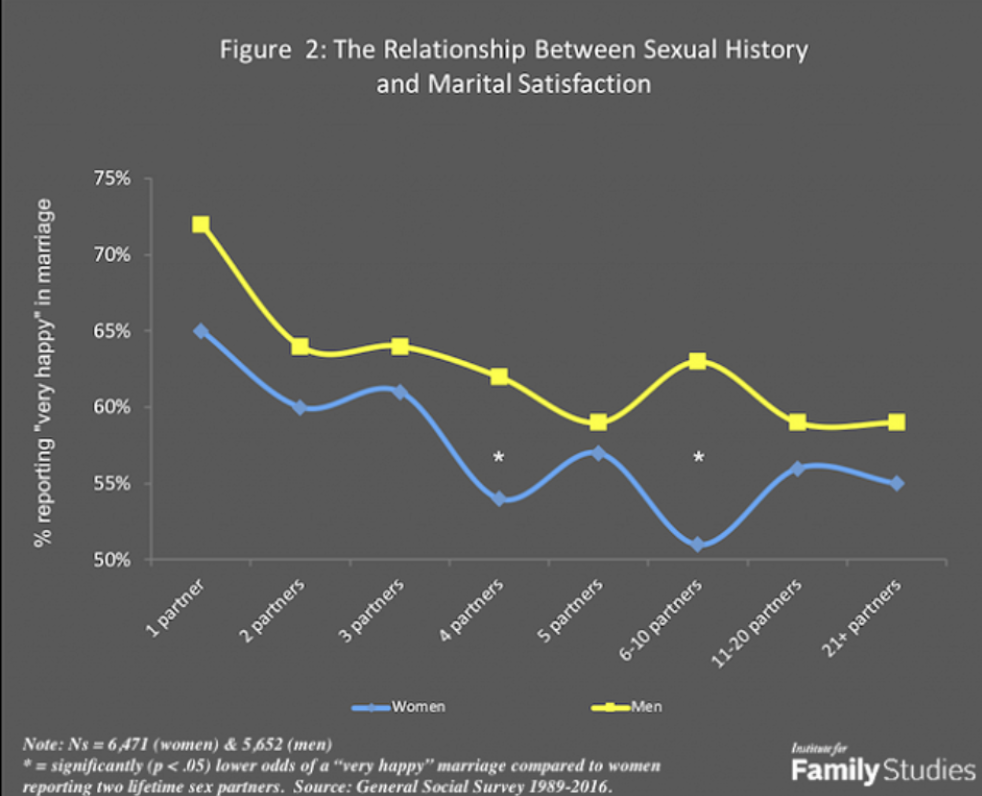
- Marital happiness levels are highest for those married whose sole lifetime sex partner is the person they are married to
- How the Bible was written out of God’s love for us
- Psychological elements involved in why lifetime monogamy is best
- More statistics on the benefits of lifetime monogomy with one spouse, including lower STI prevalence (in a time when most in the US will have an STI in their lifetime), better childhood outcomes (i.e. future income, lower abuse/neglect rates, & better relationships across numerous spectrums)
Before asking why God forbids premarital sex, we should first establish whether Scripture actually does. The Bible does not use the exact modern sentence, “Two unmarried consenting adults must not have sex,” but its teaching is cumulative and consistent: sexual union belongs within marriage, and sex outside that covenant falls under the Bible’s prohibitions of sexual immorality.
Where Scripture is less explicit, Christians should still pursue wisdom rather than asking only whether something is technically forbidden. Proverbs says, “The beginning of wisdom is this: Get wisdom. Though it cost all you have, get understanding” (Proverbs 4:7). That means seeking what best promotes love of God, neighbor, proper care for ourselves, and the flourishing of the world God made.
Does the Bible Actually Forbid Sex Before Marriage?
The Bible does not contain a verse phrased in the exact language of a modern question such as, “Two unmarried consenting adults must not have sex.” That should be acknowledged rather than hidden. Scripture, however, does not need to use twenty-first-century wording to give a clear moral teaching. Its cumulative pattern consistently places sexual intimacy within marriage and treats sex outside that covenant as morally illicit.
Marriage and “one flesh” are joined from the beginning
The Bible’s foundational description of human sexuality appears in Genesis:
“That is why a man leaves his father and mother and is united to his wife, and they become one flesh.”
—Genesis 2:24
This passage joins three realities: the formation of a new family bond, union with one’s wife, and becoming “one flesh.” Sexual union is not presented as an independent recreational act that may or may not later lead to marriage. It belongs to the husband-wife relationship.
Jesus later reaffirmed this pattern:
“The two will become one flesh. So they are no longer two, but one flesh.”
—Matthew 19:5–6
Jesus treated Genesis 2 not merely as a description of one ancient couple, but as revealing God’s intention for marriage.
Paul then applied the “one flesh” language directly to sexual intercourse. In warning Christians against sex with prostitutes, he wrote:
“Do you not know that he who unites himself with a prostitute is one with her in body? For it is said, ‘The two will become one flesh.’”
—1 Corinthians 6:16
Sex can create a real one-flesh bond even when it occurs in a sinful setting. Paul’s point is not that intercourse automatically creates a valid marriage. His point is that sex possesses a meaning and uniting power that should not be detached from the covenant to which it properly belongs.
Proverbs directs sexual desire toward one’s spouse
Proverbs does not treat sexual desire as shameful. It celebrates sexual enjoyment, but locates it within marriage:
“May your fountain be blessed,
and may you rejoice in the wife of your youth.…
May you ever be intoxicated with her love.”
—Proverbs 5:18–19
The chapter contrasts delight in one’s spouse with seeking sexual satisfaction from a “forbidden” or “strange” woman. Its immediate warning is especially concerned with adultery, so it should not be misrepresented as a standalone proof text against every form of premarital sex. Its positive sexual ethic is nevertheless clear: sexual desire is to find its joyful expression in one’s spouse. The NET Bible’s notes likewise describe this passage as affirming sexual joy within marriage while warning against unfaithfulness.[A]
Proverbs 2:16–17 also describes illicit sexuality in covenantal terms. The unfaithful woman has abandoned “the partner of her youth” and ignored “the covenant she made before God.” Biblical sexuality is therefore not governed merely by attraction or consent. It is connected to covenant, faithfulness, and accountability before God.
The Old Testament does not treat premarital sex as morally neutral
Exodus 22:16–17 addresses a man who seduces an unmarried, unbetrothed woman and sleeps with her. He is required to accept serious financial and marital responsibility, although the woman’s father may refuse the marriage.
The social and legal setting differs substantially from ours, and this passage should not be used to suggest that a woman must marry a man who exploited her. Its relevance is narrower: the law does not treat premarital sex as a private, consequence-free activity. Sexual intercourse creates obligations, affects families and futures, and may not be separated from responsibility.
Other Old Testament laws concerning sexual conduct are sometimes difficult for modern readers and require careful interpretation. Yet the general pattern remains: sexual intimacy is protected by expectations of marriage, fidelity, family responsibility, and covenant commitment. It is never presented as morally neutral merely because the participants desire it.
The New Testament directs unmarried sexual desire toward marriage
Paul’s teaching in 1 Corinthians 7 is especially important:
“But since sexual immorality is occurring, each man should have sexual relations with his own wife, and each woman with her own husband.”
—1 Corinthians 7:2
Later, while addressing unmarried people and widows, Paul writes:
“If they cannot control themselves, they should marry, for it is better to marry than to burn with passion.”
—1 Corinthians 7:9
Paul recognizes that sexual desire can be powerful. His answer is not that unmarried Christians may satisfy that desire within a loving or committed nonmarital sexual relationship. He directs them toward either self-control or marriage.
First Corinthians 7 therefore strongly supports the conclusion that marriage is the permitted setting for sexual relations.
Christians are commanded to abstain from porneia
First Thessalonians states:
“It is God’s will that you should be sanctified: that you should avoid sexual immorality; that each of you should learn to control your own body in a way that is holy and honorable.”
—1 Thessalonians 4:3–4
The Greek word commonly translated “sexual immorality” is porneia. Its meaning cannot be established simply by pointing to the older more narrow English translation “fornication” like it is in the KJV. Nor does it refer only to prostitution. It was a broad term for sexual conduct regarded as illicit within Jewish and early Christian morality, that included but was not limited to fornication.[B]
Scholars debate the precise scope of porneia in some passages, but the claim that it referred only to prostitution is too narrow. Scholarly treatments note that prostitution does not exhaust the word’s semantic range and that it could encompass a wider range of prohibited sexual conduct.[C]
The surrounding context also helps define it. When Paul addresses sexual desire, he contrasts porneia with sexual relations between a husband and wife. He does not offer nonmarital intercourse as another morally acceptable category.
The Christian command to abstain from porneia is a big deal
(ESV) But sexual immorality and all impurity or covetousness must not even be named among you, as is proper among saints.
(NIV) But among you there must not be even a hint of sexual immorality, or of any kind of impurity, or of greed, because these are improper for God’s holy people.
(NASB) But sexual immorality or any impurity or greed must not even be mentioned among you, as is proper among saints;
Acts 15 (vs 20) establishes that out of the 4 major things to request of Gentiles, abstaining from sexual immorality is one of them as a major requirement of being in the faith.
19 Therefore my judgment is that we should not trouble those of the Gentiles who turn to God, 20 but should write to them to abstain from the things polluted by idols, and from sexual immorality, and from what has been strangled, and from blood. 21 For from ancient generations Moses has had in every city those who proclaim him, for he is read every Sabbath in the synagogues.
Salvific Implications of Engagement in Porneia (as incompatible with knowing and following God)
5 passages talk about those who engage in Porneia as not inhering the Kingdom of God, as such a fundamental principle to true faith in God that those who willfully participate in it have not truly given their lives to Jesus:
1 Corinthians 6:9-10
“Or do you not know that the unrighteous will not inherit the kingdom of God? Do not be deceived: neither the sexually immoral (pornoi), nor idolaters, nor adulterers, nor men who practice homosexuality, nor thieves, nor the greedy, nor drunkards, nor revilers, nor swindlers will inherit the kingdom of God.”
Galatians 5:19-24
19 Now the works of the flesh are evident: sexual immorality, impurity, sensuality, 20 idolatry, sorcery, enmity, strife, jealousy, fits of anger, rivalries, dissensions, divisions, 21 envy,[d] drunkenness, orgies, and things like these. I warn you, as I warned you before, that those who do[e] such things will not inherit the kingdom of God. 22 But the fruit of the Spirit is love, joy, peace, patience, kindness, goodness, faithfulness, 23 gentleness, self-control; against such things there is no law. 24 And those who belong to Christ Jesus have crucified the flesh with its passions and desires.
Ephesians 5:5
For you may be sure of this, that everyone who is sexually immoral (pornos) or impure, or who is covetous (that is, an idolater), has no inheritance in the kingdom of Christ and God.”
Revelation 21:8: “But as for the cowardly, the faithless, the detestable, as for murderers, the sexually immoral (pornois), sorcerers, idolaters, and all liars, their portion will be in the lake that burns with fire and sulfur…”
Revelation 22:15: “Outside are the dogs and sorcerers and the sexually immoral (pornoi) and murderers and idolaters, and everyone who loves and practices falsehood.”
See also:
Is Repentance Required for Salvation in Christianity?
The marriage bed is distinguished from sexual immorality
Hebrews 13:4 states:
“Marriage should be honored by all, and the marriage bed kept pure, for God will judge the adulterer and all the sexually immoral.”
The verse refers both to adulterers and to the sexually immoral. That distinction matters. If all prohibited sexual behavior were simply adultery, there would be little reason to name both categories.
The passage honors the marriage bed as the proper context for sexual intimacy while warning against sexual wrongdoing beyond adultery alone.
The conclusion comes from the whole biblical pattern
No single passage must carry the entire argument. The case is cumulative:
-
Genesis places becoming one flesh within the husband-wife union.
-
Proverbs celebrates sexual satisfaction with one’s spouse.
-
Old Testament law refuses to treat premarital sex as casual or consequence-free.
-
Jesus reaffirms the Genesis pattern for marriage.
-
Paul teaches that sexual intercourse creates a one-flesh union.
-
Unmarried people experiencing strong sexual desire are directed toward self-control or marriage.
-
Christians are commanded to abstain from porneia.
-
Hebrews honors the marriage bed while warning against both adultery and other sexual immorality.
For these reasons, historic Christian teaching has understood legitimate sexual intimacy as belonging within marriage. The biblical ethic recognizes sexual faithfulness within marriage and chastity outside it. It does not establish a third category for consensual sexual relationships between unmarried people.
This conclusion should not be used to heap shame upon people who have sinned sexually. Christianity teaches both sexual holiness and the availability of forgiveness, cleansing, and restoration through Jesus. Paul’s warning against sexual sin is followed by the reminder that believers who had practiced many kinds of wrongdoing had been “washed,” “sanctified,” and “justified in the name of the Lord Jesus Christ” (1 Corinthians 6:11).
The purpose of establishing the command is not to condemn people without hope. It is to understand the biblical standard honestly before considering why that standard may be loving, wise, and conducive to human flourishing.
Sources for This Dropdown
[A] NET Bible, study notes on Proverbs 5:18–20. Used for the interpretation of the passage as an affirmation of sexual joy within marriage and a warning against sexual unfaithfulness.
[B] Steven R. Tracy, “Chastity and the Goodness of God: The Case for Premarital Sexual Abstinence,” Themelios. Used for the cumulative biblical argument and discussion of the scope of porneia.
[C] Bible Odyssey, “Sexual Immorality: A Word Study.” Used for lexical background showing that prostitution does not exhaust the meaning of porneia.
What Should We Do When Scripture Is Less Explicit?
Not every modern moral question is addressed by a verse written in the exact language we would use today. In those cases, Christians should not reduce morality to the question, “Can I find a passage that explicitly forbids this?”
Scripture instead repeatedly calls us to pursue wisdom:
“The beginning of wisdom is this: Get wisdom.
Though it cost all you have, get understanding.”
—Proverbs 4:7
Wisdom is not passive. It may require serious study, humility, patience, self-control, sacrifice, and a willingness to reconsider what we strongly want. The fact that understanding may “cost all you have” suggests that truth and wise living are worth pursuing even when they are inconvenient or personally costly.
This does not mean replacing Scripture with personal preference, cultural trends, or whatever seems beneficial in the moment. Biblical wisdom begins with reverence for God:
“The fear of the Lord is the beginning of wisdom.”
—Proverbs 9:10
It seeks to understand God’s character, the principles revealed in Scripture, and the likely consequences of our choices.
“Not explicitly forbidden” does not mean “wise”
Some people approach morality by asking only whether a particular act is directly prohibited. Scripture often asks broader and more demanding questions:
-
Is it beneficial?
-
Is it constructive?
-
Is it loving?
-
Does it strengthen or weaken self-control?
-
Could it begin to master or enslave me?
-
Does it protect or endanger another person?
-
Does it encourage faithfulness, honesty, justice, and responsibility?
-
What kind of person will this choice help me become?
-
What foreseeable effects could it have on families, children, communities, and the wider world?
Paul uses this kind of reasoning when he writes:
“‘I have the right to do anything,’ you say—but not everything is beneficial. ‘I have the right to do anything’—but I will not be mastered by anything.”
—1 Corinthians 6:12
He similarly writes:
“‘I have the right to do anything’—but not everything is constructive.”
—1 Corinthians 10:23
Christian freedom is therefore not merely freedom from rules. It is freedom to pursue what is good, loving, constructive, and worthy of people made in God’s image.
Wisdom should seek genuine human flourishing
When Scripture does not provide a detailed rule for a modern circumstance, we should seek the choice most consistent with genuine human flourishing.
That does not mean defining flourishing as immediate pleasure, comfort, or personal success. Something can feel good in the short term while harming character, relationships, health, freedom, or other people over time.
Biblical flourishing includes qualities such as:
-
love,
-
faithfulness,
-
justice,
-
truthfulness,
-
self-control,
-
mercy,
-
responsibility,
-
peace,
-
protection of the vulnerable,
-
healthy relationships,
-
and proper care for the bodies, opportunities, resources, and world God has entrusted to us.
Research and experience can help us understand how particular choices affect these goods. Evidence does not overrule Scripture, but it can help us recognize practical consequences and apply biblical principles more accurately.
Love of God should guide our choices
Jesus identified love for God as the greatest commandment:
“Love the Lord your God with all your heart and with all your soul and with all your mind.”
—Matthew 22:37
When considering a morally uncertain choice, Christians should ask whether it reflects trust in God, gratitude toward Him, and respect for His purposes.
That includes being willing to obey before we fully understand every reason behind a command. It also includes using the minds God gave us to pursue understanding rather than treating faith as an excuse for intellectual laziness.
Love of God should produce both humility and inquiry: humility enough to recognize that God may understand consequences we do not yet see, and inquiry serious enough to pursue truth wherever it leads.
Love of neighbor requires more than mutual consent
Jesus joined love of God with the command:
“Love your neighbor as yourself.”
—Matthew 22:39
Consent is morally important, but consent alone does not prove that an action is wise, loving, or harmless. Two people can agree to something that is exploitative, addictive, shortsighted, or damaging to themselves and others.
Loving our neighbor means asking not only, “Did this person agree?” but also:
-
Am I treating this person as someone made in God’s image?
-
Am I protecting or taking advantage of vulnerability?
-
Am I encouraging what is truly good for this person?
-
Could my actions produce foreseeable emotional, relational, physical, spiritual, or financial harm?
-
Am I accepting responsibility for the consequences of what I am asking another person to share with me?
Love seeks another person’s genuine good, not merely access to what we desire from them.
Proper love and care for ourselves also matter
Jesus’ command assumes a proper concern for oneself: “Love your neighbor as yourself.” Biblical love of self is not narcissism, self-worship, or the belief that personal happiness is the highest good. It means recognizing that our own bodies, minds, consciences, relationships, and futures also matter to God.
Paul writes:
“Your bodies are temples of the Holy Spirit.… You are not your own; you were bought at a price. Therefore honor God with your bodies.”
—1 Corinthians 6:19–20
Wisdom therefore asks whether a choice protects or damages our character, freedom, physical health, emotional well-being, future relationships, and ability to love and serve others.
Self-denial can sometimes be an act of proper self-love. Refusing an immediate desire may protect much greater goods that would otherwise be lost.
Love extends to families, communities, creation, and the wider world
Our choices rarely affect only ourselves. They can shape children, families, friendships, churches, workplaces, neighborhoods, institutions, and future generations.
Scripture calls people to seek justice, protect the vulnerable, exercise stewardship, and use power responsibly. Wise moral reasoning should therefore consider not only personal intent but also broader effects.
We should ask:
-
What happens if this behavior becomes normal throughout a society?
-
Who receives the benefits, and who bears the risks?
-
Are children or vulnerable people likely to suffer?
-
Does this strengthen trust and stable relationships or weaken them?
-
Does it promote responsibility or shift consequences onto others?
-
Does it reflect wise stewardship of bodies, resources, communities, and the world God made?
This does not mean reducing morality to a mathematical calculation. Some actions remain wrong even when someone believes they could produce a useful result. Consequences still matter, however, because love pays attention to what our choices actually do to people and creation.
Wisdom requires humility about both interpretation and evidence
Human beings can misread both Scripture and data. Studies can be weak, biased, outdated, or overstated. Personal experiences can be genuine without being representative. Cultural assumptions can feel obvious while being false.
The pursuit of wisdom therefore requires intellectual humility:
-
distinguish strong evidence from speculation,
-
consider alternative explanations,
-
listen seriously to correction,
-
examine long-term as well as short-term effects,
-
and remain willing to revise conclusions when better evidence appears.
Christians should not be afraid of truthful research. If all truth belongs to God, careful investigation can help us apply biblical principles more faithfully.
This article examines both command and consequence
Premarital sex is not merely a subject on which Scripture leaves us with no guidance beyond general wisdom. As the previous section explains, the broader biblical case that sexual intimacy belongs within marriage is strong.
Wisdom still matters because it helps us investigate why the command may be good. The rest of this article therefore examines evidence concerning relationships, emotional well-being, sexual health, children, family stability, cohabitation, and other measurable outcomes.
These findings do not determine whether God’s command is true, and no study proves that every person who disobeys will experience the same outcome. They can, however, help us see some of the ways biblical sexual ethics may protect human beings and promote love, responsibility, and long-term flourishing.
2. Did you know that those whose first sexual partner is their spouse correspond to statistically higher marital happiness than any other number of sexual partners, and that the difference is very significant, much more significant than the difference between having 2 and 3 prior partners? See the chart below. I also wonder about the N values (number of people who reported certain brackets) and whether some of the wave fluctuations that didn’t follow trends well are due to low N values.
3. Basics on the Inherently Loving Nature of God Giving us the Bible
There are many passages that go over the blessing of walking according to Scripture (i.e., Psalm 1), which happens inherently, not requiring God’s input outside of the Bible in order for you to be blessed. That said, God loves to stack blessings with manual divine input when you abide by His precepts, increasing the incentive to do so. The fact that God sometimes blesses people following them in doing things according to Scripture can confuse people. One of the most common misperceptions of the Bible is that God needs you or that you’re doing God a favor by abiding by His precepts. The reverse is actually true. God is doing you a favor by enabling you to have Scripture even available to you, something that most in history haven’t had readily available anywhere close to the degree that we have available now. It’s by God’s grace that you do anything according to Scripture, even after having Scripture available.
Romans 2:4 states “…God’s kindness leads you toward repentance”.
Deuteronomy 10:12-14 ESV states, “And now, Israel, what does the Lord your God require of you, but to fear the Lord your God, to walk in all his ways, to love him, to serve the Lord your God with all your heart and with all your soul (13) and to keep the commandments and statutes of the Lord, which I am commanding you today for your good? Behold, to the Lord your God belong heaven and the heaven of heavens, the earth with all that is in it.
For more details, see: Reverse Thinking About God: God Doesn’t Need Us; We Need Him
4. Some of the Psychological Factors Involved
Per Re-Examining the Link Between Premarital Sex and Divorce as published by the National Library of Medicine:
“Premarital sex predicts divorce, but we do not know why. Scholars have attributed the relationship to factors such as differences in beliefs and values, but these explanations have not been tested. It is further unclear how this relationship changes by number of sexual partners, or differs by gender. We re-examine this relationship with event history models using data from the National Longitudinal Study of Adolescent to Adult Health. Models include measures of adolescent beliefs and values, religious background, and personal characteristics, as well as approximate number of premarital sexual partners in young adulthood. We find the relationship between premarital sex and divorce is highly significant and robust even when accounting for early-life factors. Compared to people with no premarital partners other than eventual spouses, those with nine or more partners exhibit the highest divorce risk, followed by those with one to eight partners. There is no evidence of gender differences.”
Here are some of the psychological factors I believe help explain the outcomes:
Basic Survey Data Says on Marriage vs Cohabitation
5. Statistics on live-in romantic relationships vs marriages in impact on divorce rates & future marriage, i.e. in a study of 1600 people, “34% of marriages ended among those who lived together before being engaged, while just 23% of marriages ended among couples who waited until after engagement or marriage to move in together.”
Per an article titled “New DU Study Highlights Risks of Living Together Before Engagement”:
“More than half of Americans believe that moving in with a significant other before tying the knot is a good idea—that cohabitation before marriage or even engagement can increase their changes of a happy and successful marriage.
But a new national survey from the University of Denver, published by the Institute for Family Studies, says otherwise.
Psychologists and DU psychology professors Galena Rhoades and Scott Stanley say their findings indicate that living together before being engaged can actually decrease a couple’s odds of a successful marriage.
Rhoades and Stanley used a representative sample of approximately 1,600 Americans who were married for the first time between 2010 and 2019. The study found that 34% of marriages ended among those who lived together before being engaged, while just 23% of marriages ended among couples who waited until after engagement or marriage to move in together.”
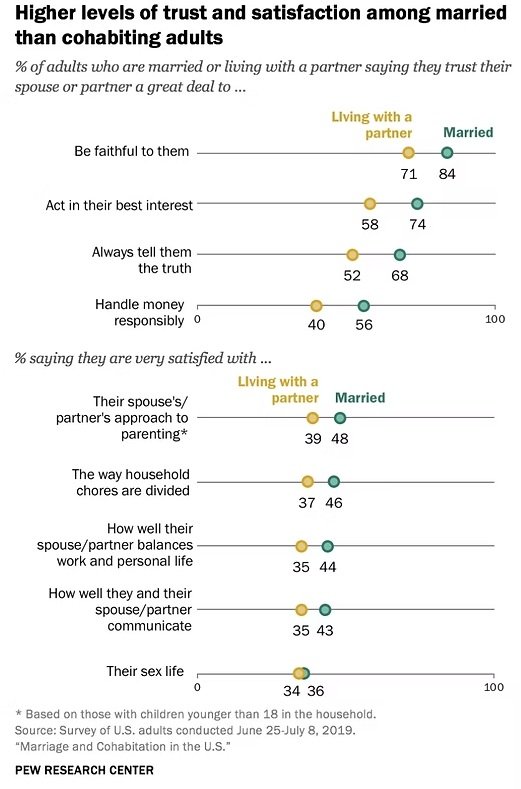
6. Statistics on trust & satisfaction regarding cohabiting adults vs married adults (better married across all 9 categories) per Pew Research
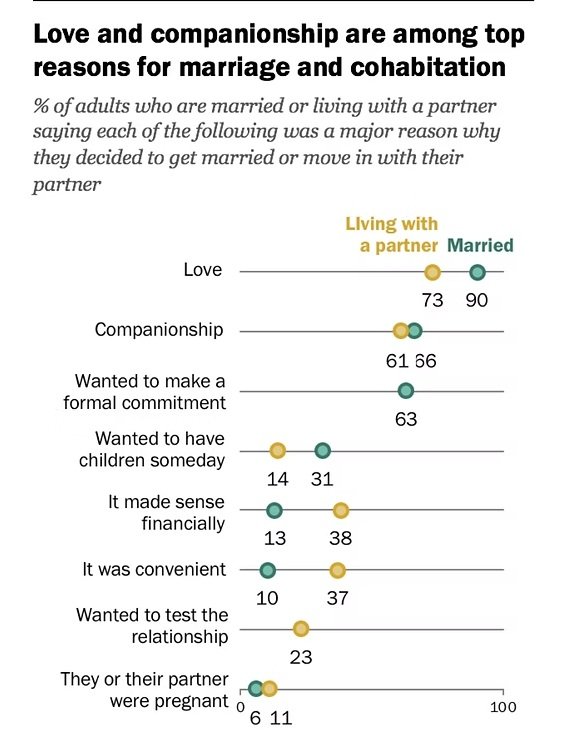
7. Love & Companionship statistics for married vs cohabiting (almost 3x as likely to cite finances as a reason to be together & almost 4x as likely to cite convenience if cohabiting vs if married)
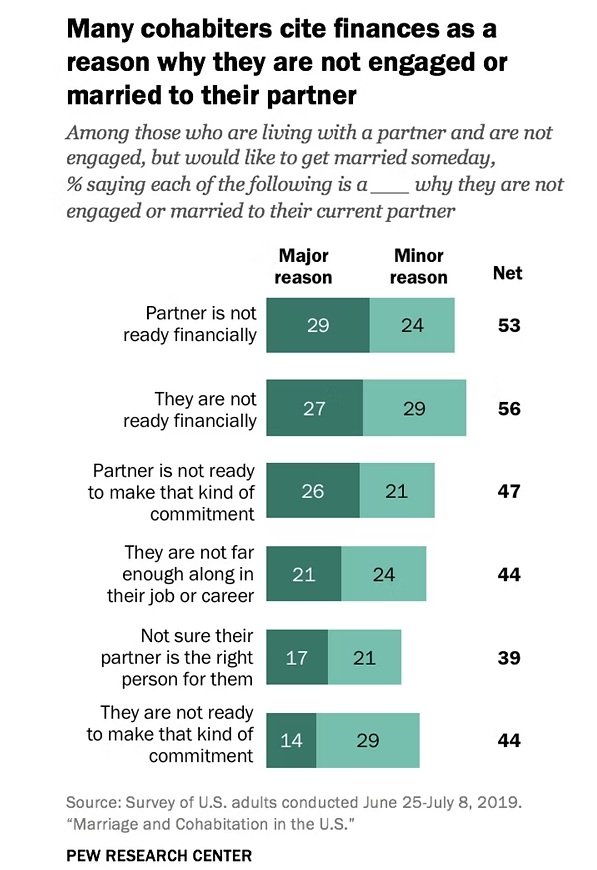
8. Financial Influence on Marriage vs Cohabitation
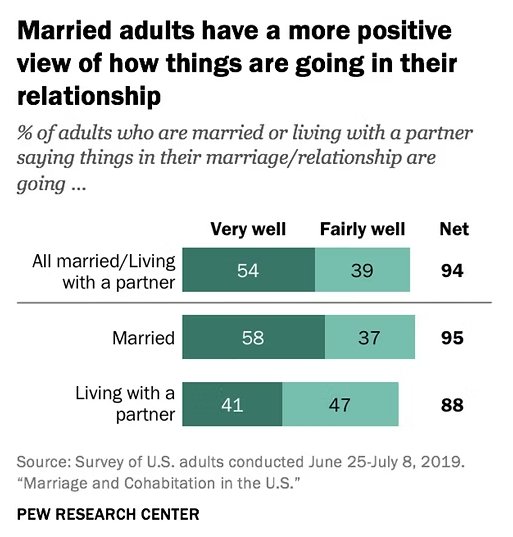
9. Married Adults have a more positive view of how things are going in their relationship
More Data
10. Statistics on marriage vs single/cohabiting on kids’ abuse/neglect, i.e. “Compared to children living with married biological parents, those whose single parent had a live-in partner were at least 8 times more likely to be maltreated in one way or another.”
Here I wanted to focus first on abuse patterns and then on income levels of children after they “grow up” following being raised in a home without a stable 2 parent environment.
Per an article published by the National Center for Health Research:
“A 2009 study by Lawrence Berger and colleagues examined whether Child Protective Services (CPS) involvement varied based on a man in the mother’s life… using data on 2,297 families… Results of the 2009 study showed that families living with a man who was not the biological father of all the children in the home, and families living without a man in the home, were significantly more likely to be contacted by CPS compared to families in which the biological father of all the children lived with the mother.“
“The following year, a report on the National Incidence Study of Abuse and Neglect, which examines not only CPS cases but all reported incidences of abuse and neglect to community professionals, also found that maltreatment rates differed according to family structure.[2] Children living with their married biological parents had the lowest rate of abuse and neglect, whereas those living with a single parent who had a partner living in the household had the highest rate. Compared to children living with married biological parents, those whose single parent had a live-in partner were at least 8 times more likely to be maltreated in one way or another. They were 10 times more likely to experience abuse and 8 times more likely to experience neglect.”
“Why Are Homes With Surrogate Fathers at Risk?
The authors of the 2009 study suggest that men who are not biologically related to their partners’ children may not feel a connection to them. As a result, surrogate fathers may not feel a reason or obligation to provide financial or emotional support, unlike a biological father. Also, because surrogate fathers are typically in undefined parenting roles, they may be less able to enforce rules or convince children to obey them, and some surrogate fathers may resort to physical force or psychological control to demonstrate power over children.
What Explains the Increase in Maltreatment in Homes Without a Male?
Researchers explain that compared to families with two biological parents, families headed by single-mothers generally have fewer resources—less time and money to allocate to parenting. As a result, single mothers often experience higher levels of stress, which can lead to impatience, the use of physical control, and neglect.”
11. Data Findings on premarital intercourse vs waiting & divorce, i.e. “Premarital sex predicts divorce” & “Previously-theorized selection mechanisms thought to explain the relationship between premarital sex and divorce are not supported.” (it’s a causal relationship
Per the 1st part of the 1st sentence of the abstract of Re-Examining the Link Between Premarital Sex and Divorce as published in the National Library of Medicine, “Premarital sex predicts divorce.” “The relationship between premarital sex and divorce is highly significant and robust. Compared to people with no premarital partners other than eventual spouses, those with six or more partners exhibit the highest divorce risk… Previously-theorized selection mechanisms thought to explain the relationship between premarital sex and divorce are not supported.”
Interestingly, “One partner is subtracted for each respondent to ensure only partners other than eventual spouses are counted.” That means that the study methods didn’t even make a difference between those who were virgins when they got married and those whose first sexual partner was their spouse prior to marriage. If they did, the full text of the study states effectively that the difference would likely be even higher. It states, “Premarital sex is linked to higher rates of divorce (Kahn and London, 1991; Paik, 2011), particularly when it involves partners other than one’s eventual spouse (Teachman, 2003).”
Keep in mind the lack of bias in that study as well. I asked Chat GPT 5 on 11.7.25, “Are any of these Christian or religious? “Eunice Kennedy Shriver National Institute of Child Health and Human Development (NICHD) to the Population Research Institute at The Pennsylvania State University for Population Research Infrastructure (P2C HD041025) and Family Demography Training (T-32HD007514)”? Taken from https://pmc.ncbi.nlm.nih.gov/articles/PMC10989935/“
It responded, “No — none of the organizations or grants mentioned in that citation are Christian or religious in nature. Here’s a breakdown:
Eunice Kennedy Shriver National Institute of Child Health and Human Development (NICHD):
A U.S. government agency that’s part of the National Institutes of Health (NIH). It focuses on biomedical and public health research related to children, families, and development. It’s completely secular and publicly funded.
Population Research Institute at The Pennsylvania State University:
This is an academic research institute within Penn State, focused on demography (population studies, family trends, fertility, etc.). It is not affiliated with any religion.
Population Research Infrastructure (P2C HD041025) and Family Demography Training (T-32HD007514):
These are NIH grant numbers, funding secular research projects and training programs. They’re administrative identifiers, not organizations.
So, the citation refers entirely to secular, government-funded academic research bodies, with no Christian or religious affiliation…”
12. Statistics on marriage vs single/cohabiting on kids’ family’s income as a kid & after “growing up”, i.e. “People raised outside stable two-parent homes were approximately 250 % more likely to grow up in the bottom income quintile (bottom 20% income levels)” & “Regardless of parental income, these people are relatively likely to become low-income adults
Per the 1st part of the 1st sentence of the abstract of Re-Examining the Link Between Premarital Sex and Divorce as published in the National Library of Medicine, “Premarital sex predicts divorce.” “The relationship between premarital sex and divorce is highly significant and robust. Compared to people with no premarital partners other than eventual spouses, those with six or more partners exhibit the highest divorce risk… Previously-theorized selection mechanisms thought to explain the relationship between premarital sex and divorce are not supported.”
Interestingly, “One partner is subtracted for each respondent to ensure only partners other than eventual spouses are counted.” That means that the study methods didn’t even make a difference between those who were virgins when they got married and those whose first sexual partner was their spouse prior to marriage. If they did, the full text of the study states effectively that the difference would likely be even higher. It states, “Premarital sex is linked to higher rates of divorce (Kahn and London, 1991; Paik, 2011), particularly when it involves partners other than one’s eventual spouse (Teachman, 2003).”
Keep in mind the lack of bias in that study as well. I asked Chat GPT 5 on 11.7.25, “Are any of these Christian or religious? “Eunice Kennedy Shriver National Institute of Child Health and Human Development (NICHD) to the Population Research Institute at The Pennsylvania State University for Population Research Infrastructure (P2C HD041025) and Family Demography Training (T-32HD007514)”? Taken from https://pmc.ncbi.nlm.nih.gov/articles/PMC10989935/“
It responded, “No — none of the organizations or grants mentioned in that citation are Christian or religious in nature. Here’s a breakdown:
Eunice Kennedy Shriver National Institute of Child Health and Human Development (NICHD):
A U.S. government agency that’s part of the National Institutes of Health (NIH). It focuses on biomedical and public health research related to children, families, and development. It’s completely secular and publicly funded.
Population Research Institute at The Pennsylvania State University:
This is an academic research institute within Penn State, focused on demography (population studies, family trends, fertility, etc.). It is not affiliated with any religion.
Population Research Infrastructure (P2C HD041025) and Family Demography Training (T-32HD007514):
These are NIH grant numbers, funding secular research projects and training programs. They’re administrative identifiers, not organizations.
So, the citation refers entirely to secular, government-funded academic research bodies, with no Christian or religious affiliation…”
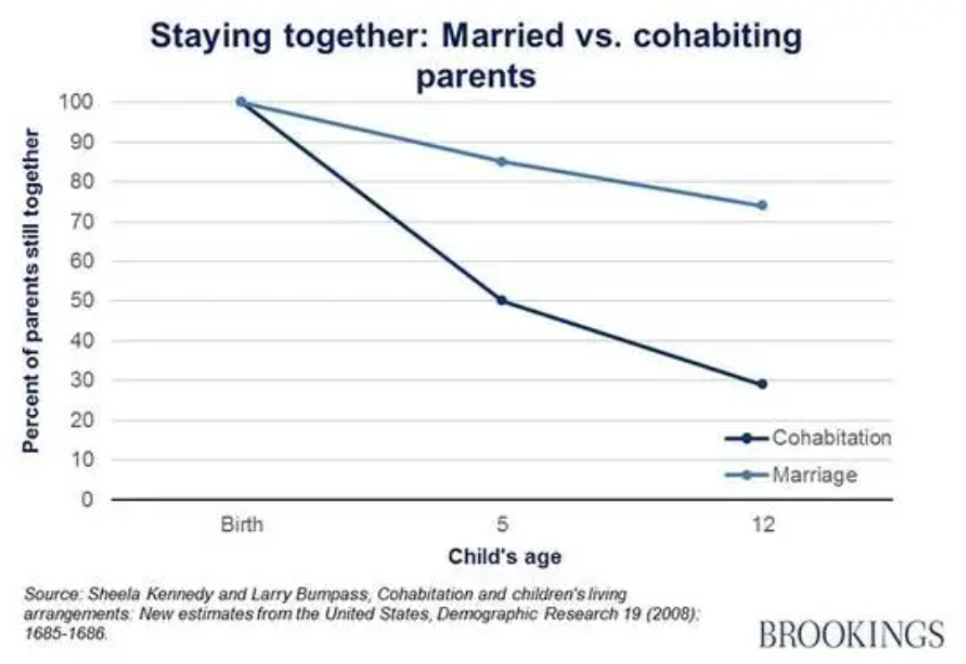
13. Statistics on the likelihood of staying together for married vs cohabiting parents: cohabiting parents are more than 2x as likely to break up
Per the Brookings Institute, “Children born to cohabiting couples do worse because their parents are much more likely to break up; two-thirds have split up before their child reaches age 12, compared with a quarter of married parents.”
14. Statistical Sexually Transmitted Illness Likelihood, i.e. “over half of people in the U.S. will get an STI sometime during their lifetime.”
Per “Public Knowledge and Attitudes About Sexually Transmitted Infections: KFF Polling and Policy Insights” (2020)
“Large majorities of the public are unaware of how common STIs are among adults in the U.S. About one-third (36%) are aware that STIs have become more common over the past decade and few (13%) know that over half of people in the U.S. will get an STI sometime during the(ir) lifetime.”
A few of the most important distinctions that should be taught more in schools regarding STI’s & STD’s are:
-
The probability increases over time rather than exclusively over the course of 1 year or per act & hoping that students will do the math themselves.
-
The probability increases according to partner volume
-
The probability increases based on frequency within 1 year
-
The statistics that are available for both “perfect” condom usage and typical usage.
15. Statistical Pregnancy Likelihood Over Time
The most important distinction that should be taught more in school is the probability increase over time of pregnancy rather than exclusively over the course of 1 year & hoping that students will do the math themselves.
In addition, it should be taught more that around half of abortion patients used contraception in the month prior to that abortion, including (among other forms of protection, i.e. sterilization & IUD’s) 24% condoms and 13% the pill in a 2014 study on contraception & abortion published by the National Library of Medicine.
Some might attempt to ameliorate their chances of becoming pregnant via anal penetration, but there are studies on per act disease contraction for HIV by the CDC (sadly not for other STI’s I could find), & per those studies, your chances of contraction are over 15x higher on the receiving end for anal penetration vs any oral or vaginal intercourse, with the second highest method of contraction being anal penetration on the insertive end.
If one were to shift exclusively to oral sex, it’s important to note that, per VerywellHealth, at least 5 STI’s are spread by skin-to-skin contact where condoms don’t provide even decent protection. Some of these (i.e. HPV) have vaccines, while others don’t.
16. Why so few virgins before marriage?
Why do so few married couples follow best practices that reflect the data we have now? Here are some of my hypotheses:
-
Herd bias which is in contrast to historic precedent (especially within Christianity) regarding physical intimacy prior to marriage (including non-sexual), is one of the biggest factors involved.
-
Historically unprecedented lowering of standards regarding non-sexual physical intimacy and the serotonin, oxytocin, etc. involved that impacts judgment and creates drug/addictive type effects (see brain studies comparing porn and drugs) with non-sexual intimacy effectively serving as the gateway drug.
-
Changes in law regarding contraceptives & abortion have played a major role.
-
Most of the data hasn’t been out very long. While it’s out there, it’s not widely known and not commonly taught in sex education. When it’s taught, it’s not often taught well, i.e., typically not using statistical long-term data rather than exclusively 1-year data.
-
Pornography usage (particularly among men) and sexualized media have become popularized.
-
There’s societal pressure and pressure within relationships.
-
Historically, physical intimacy prior to marriage wasn’t nearly as popular as it is today. Physical intimacy impacts judgment via oxytocin etc., lowering inhibitions to go deeper into physical intimacy and cross into sexual intimacy. Oxytocin and other hormonal drivers increase during sex even more than they do in non-sexual physical intimacy & have drug-like impacts on judgment that are addictive.
-
Misunderstanding regarding the true probability over time of contracting an STI or becoming pregnant.