Why Climate Change Matters: A Christian Case for Taking It Seriously
Climate change is often treated as a political identity test. It should not be.
The more basic question is moral and practical: If a changing climate is increasing risks to our neighbors, future generations, communities, food and water systems, and the rest of creation, how seriously should we take those risks?
Two related questions deserve separate treatment:
This article asks the next question: Why does combating climate change matter?
The answer does not require believing that civilization is about to collapse, accepting every alarming headline, or endorsing a particular political party or climate policy. Climate risks exist on a spectrum. The IPCC’s central conclusion is that every additional increment of warming increases multiple risks, while faster mitigation and adaptation reduce projected losses and damages.
For Christians, there is another question as well: if the earth belongs to God, and if our neighbors bear the image of God, what responsibilities follow when our choices can harm both?
Climate Change Does Not Have to Be Apocalyptic to Matter
Summary: The choice is not between “nothing happens” and “the world ends.” Relatively modest changes in averages can substantially increase real-world risks.
One of the most unhelpful ways to discuss climate change is as an all-or-nothing proposition.
If someone predicts human extinction and that prediction is exaggerated, it does not follow that climate change is harmless. Likewise, showing that humanity can adapt to some warming does not establish that additional warming is cost-free.
Climate risk generally works incrementally.
A somewhat higher average sea level makes coastal floods easier to trigger. More extreme heat increases health risks. Shifts in rainfall can make existing drought or flood problems worse. Ecosystems already under other pressures receive another source of stress.
The IPCC concludes that risks and losses increase with each additional increment of warming and that some ecosystems and communities are already encountering limits to adaptation. It also concludes that delaying mitigation increases future losses, damages and costs. [1]
That makes climate change fundamentally a risk-management problem.
We routinely spend money and change behavior to reduce risks that are far below 100% certain. We buy insurance, strengthen buildings, use seat belts, maintain bridges and prepare for hurricanes. The relevant question is not whether every predicted consequence is guaranteed. It is whether the probability and magnitude of preventable harm justify reasonable action.
Examples of Flooding Increases Below Close to Where I live in Southeast Virginia:
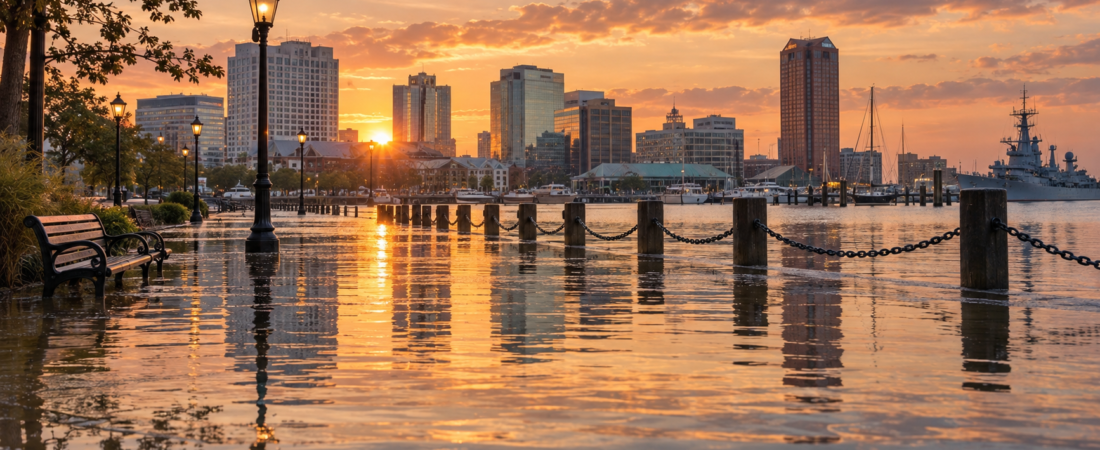
Norfolk Shows How a Small Change in the Baseline Can Produce a Big Change in Flooding
Summary: Hampton Roads provides a particularly useful example because nearly a century of measurements show what happens when rising water gets closer to a flooding threshold.
At NOAA’s Sewells Point tide gauge in Norfolk, the long-term relative sea-level trend is about 4.79 millimeters per year, equivalent to approximately 1.57 feet per century if that historical linear trend simply continued. [2]
That local number is not caused by global climate change alone. Norfolk’s relative sea-level change reflects a combination of global sea-level rise, sinking land, and regional oceanographic effects. Weather and ocean conditions also cause large variations from one year to another. NOAA specifically identifies these multiple factors. [3]
But the flooding record demonstrates something important about climate risk:
Consequences do not necessarily increase at the same rate as the underlying physical change.
Imagine a road that floods when the water reaches a particular elevation.
When normal high tide sits well below that elevation, it may take an exceptional storm to flood the road.
Raise the starting water level several inches, and a smaller storm may do it.
Raise it farther, and an unusually high tide combined with an ordinary wind may be enough.
Eventually, flooding that was once rare becomes routine.
That threshold effect is visible in Norfolk’s actual record.
NOAA’s calendar-year data at Sewells Point show an average of only about 0.8 minor high-tide-flood days per year from 1928–1959. From 2020–2025, the average was about 15.7 per year—roughly 19 times the earlier average. NOAA recorded 17 days in 2023, 20 in 2024 and 17 in 2025. [4]
Norfolk below is an example of the impact of climate change, including but not limited to rising sea levels in Norfolk, the city where I went to my senior prom at my high school & where my dad lives today:
Norfolk High-Tide Flooding, 1928–2025
Norfolk’s recorded high-tide flooding has become dramatically more frequent. NOAA’s Sewells Point record averages about 0.8 minor high-tide-flood days per year from 1928–1959, compared with about 15.7 days per year from 2020–2025 — roughly 19 times as many recorded flood days. Individual years still vary because tides, storms, winds and other conditions vary. The red 10-year trailing average helps show the long-term change beneath those year-to-year fluctuations.
There is an important caveat in the historical data. Some early years contain incomplete observations—especially 1942 and 1943—so the comparison should not be presented as perfect precision. The overall long-term change, however, is much larger than those data gaps. NOAA’s recent years are complete.
And the problem does not end with today’s flooding.
Using updated sea-level methodology, NOAA estimated approximately 85–125 high-tide-flood days per year at Sewells Point around 2050 under the sea-level trajectories it considers appropriate for the location. [5]
That would not mean Norfolk is underwater 85–125 days each year. Minor high-tide flooding is generally shallower and more disruptive than catastrophic. But repeated flooding can close roads, overwhelm drainage, accelerate infrastructure deterioration and impose cumulative costs.
Norfolk therefore illustrates why phrases such as “only several inches of sea-level rise” can be misleading.
Several inches can be enough to push many more tides across an existing threshold.
Tangier Island Shows That Communities Can Be Lost Before They Are Literally Underwater
Summary: A community does not need to be completely submerged for rising water, erosion and land loss to threaten its viability.
Tangier Island provides another Virginia example, but a very different one.
A peer-reviewed study reconstructing Tangier’s landmass from 1850 through 2013 found that only about 33% of its 1850 land area remained by 2013. The researchers modeled the combined effects of relative sea-level rise, erosion and land loss and concluded that much of the remaining island could disappear during this century. Their mid-range scenario suggested the town could become uninhabitable around 2063, although protective engineering could alter that outcome. [6]
That distinction matters.
Tangier is not simply a bathtub in which you raise the water three feet and see what remains. Shorelines erode. Marshes disappear. Tidal channels expand. Protective landforms can be lost. The land itself is also subsiding.
Recent reporting from Tangier in 2026 found that these issues remain active concerns, with engineers and residents pursuing substantial interventions to preserve the community.
So the reasonable claim is not:
“Climate change will definitely put every part of Tangier underwater by a particular year.”
It is:
Tangier is already extremely vulnerable, and additional sea-level rise makes preserving an inhabited centuries-old Virginia community substantially more difficult and expensive.
That is a real cost even if engineers ultimately succeed in saving it.
[Picture placement: strong aerial or shoreline photograph of Tangier Island here. Caption should emphasize erosion + relative sea-level rise rather than implying climate change alone caused all historical land loss.]
30 Year Flood Projection Differences from First Street (Example in Eastern South Side of Hampton Roads, VA, which is currently superior to flood risk vs many East Coast areas)
First Street has flood risk projections today and 30 years from now. I have a subscription with First Street for risk analysis in my work as a real estate agent, frequently using the subscription with clients. Here are some examples on how flood risk (& flood insurance rates) will increase over time (see more details, including maps, on my article on Hurricane Evacuation Zones & Local Flood Zone Projections as well as my guide to Weather & Environmental Conditions That Affect Homeownership in Virginia)
| Area | Flood Risk Now* | Flood Risk in 30 Years* | Typical Home Value** | Median Household Income*** | Population Density*** |
|---|---|---|---|---|---|
| Portsmouth | Very High | Exceptionally High | ~$260k | ~$58k | ~3,000 per sq. mi. |
| Norfolk | High | Exceptionally High | ~$315k | ~$63k | ~4,450 per sq. mi. |
| Virginia Beach I graduated from Regent University here. | Moderate | Very High | ~$427k | ~$91k | ~1,860 per sq. mi. |
| Chesapeake | Moderate | High | ~$405k | ~$104k | ~760 per sq. mi. |
* Flood-risk classifications and projections.
** Typical home values are approximate.
*** Household income and population-density figures are approximate.
30 Year Flood Projection Differences from First Street (Example in Eastern Peninsula of Hampton Roads, VA)
| Area | Flood Risk Now* | Flood Risk in 30 Years* | Typical Home Value** | Median Household Income*** | Population Density*** |
|---|---|---|---|---|---|
| Poquoson | Extreme | Extreme | ~$515k | ~$122k | ~700 per sq. mi. |
| Hampton I own a house here as of 6/17/26; the projected increase is one of the reasons why I plan to sell. | Very High | Exceptionally High | ~$290k | ~$67k | ~2,650 per sq. mi. |
| York County I lived here for over a decade. | Moderate | High | ~$465k | ~$116k | ~690 per sq. mi. |
* Flood-risk classifications and projections.
** Typical home values are approximate.
*** Household income and population-density figures are approximate.
Is there Significant Evidence That Humans are the Primary Driver for Climate Change? Yes
Evangelicals globally have acknowledged this fact. For more details, see the section on “Spectrum of Christian & Non-Christian Perspectives on Climate Change” and go to the evangelical section, or go to The Largest Recent Global Evangelical Agreement in 2010 Acknowledged Climate Change as the Greatest Threat to the Physical World.
The evangelical response in the US is more influenced by US Republican party herd bias than Bibles. I say that as someone who typically votes Republican.
For those wondering how I could support any Republican candidate, since some believe that doing so is inherently immoral, it’s due to the heavy amount of compromises that need to be made when considering many positions where each side often has numerous unbiblical views, when I live in a 2 party nation where a vote typically won’t effectively count without a high volume of compromises when casting one in elections with only 2 major candidates.
What’s the Big Deal With a Few Degrees? (i.e., 150 Million Extra Dying from half a degree increase due to air pollution alone projected)
How to View Creation & Climate Change
Creation Itself Has Value Beyond What It Can Immediately Give Us
Summary: Christian creation care should not be reduced to saving resources merely because humans may want to consume them later.
Christian theology begins with a surprisingly strong environmental premise:
The world does not ultimately belong to us.
“The earth is the LORD’s, and everything in it.” — Psalm 24:1
Genesis portrays humanity as receiving both authority and responsibility within creation. Genesis 2:15 describes the human vocation in the garden in terms commonly translated as working and keeping or caring for it.
Romans 8 goes even further. Creation is included in Paul’s description of a world groaning under corruption and awaiting restoration.
These texts are not modern climate-science textbooks, and we should not pretend that they directly answer questions about carbon dioxide concentrations, climate sensitivity or energy policy.
They establish something more foundational:
Creation matters to God, and human authority over creation is not permission for careless destruction.
Species, forests, oceans, coral reefs and ecosystems are valuable not merely because they can make humans money, but because they belong to the Creator.
Climate Change Is Also a Human-Health Issue
Summary: Climate change affects people through heat, flooding, food and water insecurity, infectious disease and disruption of health systems.
Environmental problems can sound abstract until we remember that human beings live inside the environment.
The World Health Organization identifies climate change as a major threat to human health through extreme heat, storms, flooding, wildfire, food-system disruption, water insecurity and changes in some infectious diseases. It estimates that 3.6 billion people live in areas highly susceptible to climate change. [7]
WHO also estimates approximately 250,000 additional deaths per year between 2030 and 2050 from undernutrition, malaria, diarrheal disease and heat stress alone. That estimate does not attempt to count every possible climate-related health pathway.
Heat deserves particular attention because it is one of the most direct relationships.
WHO reports that exposure to extreme heat is increasing in every world region and that heat can aggravate cardiovascular disease, diabetes, respiratory disease and other conditions.
None of this means that every heat death, flood or disease outbreak should be attributed to climate change.
It means that changing the background climate can change the probability or severity of hazards that already kill people.
Again, the important concept is changing risk—not claiming climate change independently causes every disaster.
The People With the Fewest Resources Often Have the Least Ability to Adapt
Summary: Climate change raises a justice problem because vulnerability and responsibility are not distributed equally.
A wealthy coastal homeowner may be able to elevate a house, install flood barriers, improve air conditioning, increase insurance coverage or relocate.
A subsistence farmer experiencing repeated crop losses may have none of those options.
A wealthy country can spend billions on seawalls, drainage systems, desalination, stronger buildings and emergency response.
A poor country cannot do so nearly as easily.
The IPCC concludes with high confidence that vulnerable communities that historically contributed least to current climate change are disproportionately affected. [1]
WHO similarly reports that areas with weak health infrastructure are among those least able to prepare for and respond to climate-related health threats.
That makes climate change more than an environmental question.
For Christians in particular, it intersects with our concern for the poor, the vulnerable and the neighbor whose interests are easier to ignore because that neighbor lives thousands of miles away.
Loving Your Neighbor Includes Preventable Environmental Harm
Summary: Christian love is difficult to reconcile with indifference to harms we can reasonably reduce.
Jesus summarized the second great commandment as:
“Love your neighbor as yourself.” — Matthew 22:39
That command does not specify a preferred climate model or public policy.
But it does establish the moral direction.
If our behavior imposes foreseeable costs upon others, particularly people with fewer resources to protect themselves, Christians have reason to ask whether those costs can reasonably be reduced.
The same logic already appears throughout Christian ethics.
We care about unsafe working conditions even if the worker lives overseas.
We care whether products were produced using slave labor even if we never meet the victims.
We care about pollution in someone else’s drinking water.
Distance does not turn a neighbor into a nonperson.
Climate change raises the same kind of question across both geography and generations.
People born decades from now have no vote in the decisions we make today, but they will inherit many of their consequences.
Responses to Objections on Christian Advocacy to Mitigate Climate Change
Can’t We Just Adapt Instead of Trying to Prevent Warming?
Summary: Adaptation is essential, but adaptation and mitigation solve different parts of the problem.
We should adapt.
Norfolk needs better drainage and flood protection whether emissions fall rapidly tomorrow or not. Tangier may need shoreline protection and land restoration. Farmers need drought- and heat-resilient practices. Cities need heat plans.
Some future climate change is already unavoidable.
But adaptation asks:
How can we better withstand the change that occurs?
Mitigation asks:
How much additional change can we prevent?
Those are complementary rather than competing questions.
The IPCC finds that adaptation has already produced benefits, but also that adaptation gaps are growing and that some human and ecological systems are encountering limits. It concludes that combining accelerated adaptation with mitigation reduces projected losses and damages more than relying on adaptation alone.
There is a simple reason.
You can raise a seawall.
If the sea continues rising, eventually you must raise it again.
At some point, protecting every place may become technically impossible or economically irrational.
Reducing the amount of future warming reduces the size of the problem future generations have to adapt to.
Taking Climate Change Seriously Does Not Require Supporting Every Proposed Solution
Summary: The existence of a moral responsibility does not settle every prudential question about how to fulfill it.
This distinction is essential.
Christians can agree that we should reduce preventable environmental harm while disagreeing about the best combination of:
energy technologies, market incentives, regulation, nuclear power, renewable energy, carbon capture, conservation, adaptation spending, transportation systems and other approaches.
Every option involves tradeoffs.
Energy must remain reliable and affordable. Poor households can be harmed by badly designed transitions. Mining and manufacturing have environmental impacts of their own. Some climate programs may accomplish little despite costing a great deal. Others may produce benefits exceeding their costs.
Consequently:
“Climate change matters” does not logically mean “every climate policy is good.”
But the reverse is also true:
Finding a bad climate policy does not demonstrate that the underlying problem is imaginary.
Those are separate questions.
For public-policy decisions, the useful questions are factual ones: How much warming or climate risk is this proposal expected to reduce? What does it cost? How reliable is the technology? Who bears the costs? Who receives the benefits? What alternatives accomplish the same goal more effectively?
Christians can disagree on those answers without pretending that stewardship and neighbor love disappear whenever an issue becomes politically inconvenient.
Spectrum of Christian & Non-Christian Perspectives on Climate Change
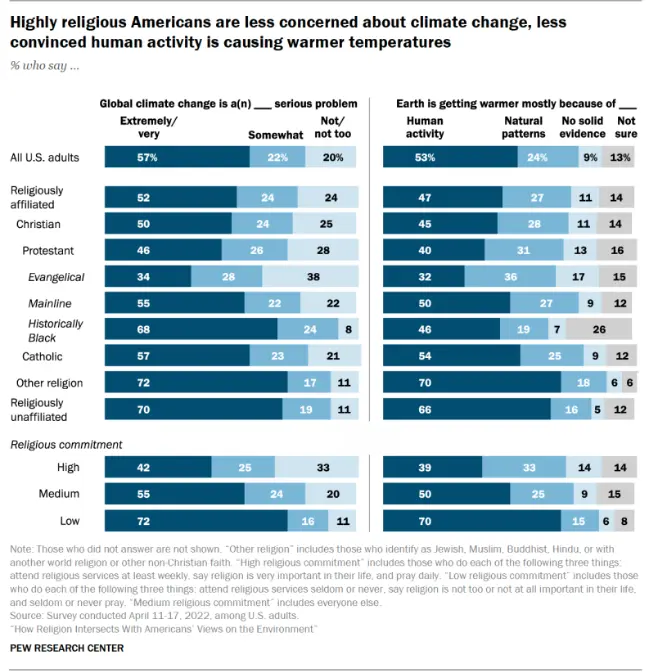
The Sad State of Climate Change Source View Differences in Viewpoints by Religion in the US
Viewpoints on climate in the US align far more with political party than with Bibles. For instance:
– evangelicals have the highest apathy about climate change among groups in the survey below.
– those of other religions than Christianity had the highest % who felt that global cimate change is an extremely/very serious problem
– those with high religious committment had the lowest % among committment levels who felt that global cimate change is an extremely/very serious problem.
– those with low religious committment had the highest % among committment levels who felt that global cimate change is an extremely/very serious problem.
Global Evangelical View is Very Different than the US: The Cape Town Commitment in 2010, Endorsed by the World Evangelical Alliance, the Largest Umbrella Group for Global Evangelicals Representing 600 Million People, Spoke Directly About Fighting Climate Change
Summary: Creation care and concern about climate change have substantial roots within global evangelical Christianity.
American political categories & political herd bias can give Christians a distorted picture of the global church.
The Cape Town Commitment, endorsed by many, including the top umbrella group of evangelicals in the world (the World Evangelical Alliance, who helped draft it), representing over 400 million of them, stated:
- Humans were causing a significant amount of climate change,
- The negative impact on people of climate change
- The need to change the world to be a better place.
The subsequent Lausanne/World Evangelical Alliance creation-care process went further, calling for both substantial reductions in greenhouse-gas emissions and greater resilience for vulnerable communities. [9]
One does not have to agree with every recommendation those evangelical leaders made.
Their existence is nevertheless important.
Concern about climate change cannot accurately be dismissed as something Christians necessarily imported from secular environmentalism.
For many Christians around the world, creation care grows directly out of beliefs about creation, stewardship, justice, neighbor love and the lordship of Christ.
Video by Pope Leo XIV on Climate Change & Creation Care in June 2026
What Should Christians Take Away From This?
Climate change should neither become a substitute religion nor be ignored because people we disagree with care about it.
Christians have unusually strong reasons to resist both mistakes.
We believe creation has a Creator.
We believe human beings are stewards rather than absolute owners.
We believe loving our neighbors matters.
We believe the poor and vulnerable matter.
We believe truth matters even when facts are inconvenient to our political or cultural tribe.
And Christianity gives us no promise that irresponsible choices will magically escape their ordinary consequences.
The evidence does not require panic.
It does justify seriousness.
If we can reduce substantial future harm to people and creation at reasonable cost, that is not a distraction from Christian ethics. It is one application of them.
Sources Cited
[1] Intergovernmental Panel on Climate Change — AR6 Synthesis Report and Summary for Policymakers. The IPCC concludes that climate risks increase with additional warming, vulnerable populations are disproportionately affected, adaptation has limits, and combined mitigation and adaptation reduce future losses and damages.
[2] NOAA Tides & Currents — Sewells Point, Virginia, sea-level record. NOAA reports a long-term relative sea-level trend of approximately 4.79 mm/year, equivalent to about 1.57 feet per century under a linear extrapolation.
[3] NOAA — Annual High Tide Flooding Outlook. NOAA describes Mid-Atlantic relative sea-level change as reflecting global sea-level rise, land subsidence and regional oceanographic effects.
[4] NOAA CO-OPS — Sewells Point annual high-tide-flood dataset. Primary data underlying the Norfolk widget.
[5] NOAA — High Tide Flooding Methodology Update. Updated methodology places Sewells Point around 85–125 high-tide-flood days per year by approximately 2050 under the relevant bounding sea-level scenarios.
[6] Schulte, Dridge & Hudgins, Scientific Reports — “Climate Change and the Evolution and Fate of the Tangier Islands of Chesapeake Bay, USA.” Historical land-loss reconstruction and projections for Tangier.
[7] World Health Organization — Climate Change and Health. Reviews climate-related risks involving heat, flooding, storms, disease, food and water systems and vulnerable populations.
[8] Lausanne Movement — The Cape Town Commitment. Global evangelical statement connecting creation care with Christian discipleship and addressing climate change and poverty.
[9] Lausanne Movement / Creation Care Network — Creation Care and the Gospel: Call to Action. Evangelical creation-care statement addressing greenhouse-gas reduction and resilience.
AI Disclsoure:
This article was developed with AI assistance through an iterative process involving human direction, correction, theological judgment, revision, and final editorial review. AI helped with research workflows, organization, drafting, critique, clarity, and/or editing so that more careful, publishable work could be completed within real time and resource constraints. The final claims, wording, citations, and publication decisions remain my responsibility.
For more, see: How YGod Uses AI.